Sarjapur Road Real Estate 2026: Prices, Trends & Investment Guide
Few corridors capture Bangalore’s growth story as clearly as Sarjapur Road. This guide is a complete buyer’s view of Sarjapur Road real estate in 2026 – why the corridor is booming, where prices sit, what infrastructure is coming, and how to invest wisely. Our team has tracked this micro-market closely, and the analysis below should help you decide whether Sarjapur Road real estate fits your budget, your commute, and your long-term plans, whether you are buying a first home or building a property portfolio.
Why Sarjapur Road Real Estate Is Booming
The engine behind Sarjapur Road real estate is jobs. The corridor sits beside the Outer Ring Road tech belt – RMZ Ecoworld, Embassy Tech Village, and the wider Bellandur-Marathahalli cluster – where hundreds of thousands of professionals work. That concentration of high-paying employment drives relentless housing demand, and Sarjapur Road real estate has been a primary beneficiary because it offers homes within a reasonable commute at more accessible prices than the ORR core.
A decade ago much of this stretch was farmland; today Sarjapur Road real estate spans everything from budget apartments to premium gated communities and villa plots. The transformation has been rapid but grounded in genuine end-user demand rather than speculation, which is why values have proven resilient through market cycles.
Sarjapur Road Real Estate Price Trends
Prices across Sarjapur Road real estate vary by pocket. Mid-segment apartments typically range from Rs 7,000 to Rs 8,500 per sq ft, while branded high-rises command Rs 9,000 to Rs 11,000. Plotted developments and villas sit higher on a land-value basis. Over the past three years, Sarjapur Road real estate has appreciated at a mid-single-digit to high-single-digit annual pace, outperforming many older, fully-built parts of the city.
| Segment | Rate/sqft |
|---|---|
| Mid apartments | Rs 7-8.5k |
| Premium hi-rise | Rs 9-11k |
| Appreciation | 6-9%/yr |
| Rental yield | 2.8-3.8% |
Infrastructure Driving Sarjapur Road Real Estate
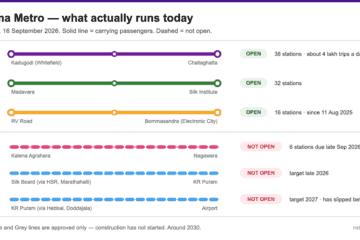
Infrastructure is the biggest catalyst for Sarjapur Road real estate. The proposed metro line toward the corridor, the widening of Sarjapur Road, and peripheral ring road proposals all promise to ease the congestion that is the area’s main weakness. Historically, such projects re-rate land values within a few kilometres as they near completion.
Office supply along the ORR continues to expand too, adding to the tenant and buyer base that underpins Sarjapur Road real estate. As connectivity improves, the corridor’s current traffic discount should narrow, which is precisely the kind of upside long-term investors in Sarjapur Road real estate are positioning for. You can follow metro progress on the official BMRCL site.
Best Localities in Sarjapur Road Real Estate
Within Sarjapur Road real estate, several pockets stand out. Sompura and the Sarjapur town end offer the best value for mid-segment buyers, with newer launches at accessible rates. The stretch closer to Bellandur and the ORR carries a premium for its shorter commute. Areas around Dommasandra and Chandapura balance affordability with improving connectivity.
For first-time buyers and investors, the value end of Sarjapur Road real estate – around Sompura Gate – often delivers the best balance of price, rental demand, and appreciation potential. A good example of value-segment Sarjapur Road real estate is the Bhavisha Gardeniaa Phase 4 community, a low-rise gated project priced from Rs 71 lakh.
Investing in Sarjapur Road Real Estate
For investors, Sarjapur Road real estate offers a rare combination: reliable rental demand from IT tenants, steady capital appreciation, and a deep resale market. Gross rental yields of 2.8 to 3.8 percent, paired with mid-single-digit appreciation, produce a total return competitive with most Bangalore corridors, and the upcoming infrastructure adds a credible upside catalyst.
The smart approach to Sarjapur Road real estate is to buy quality at a fair price in a pocket with both current demand and future connectivity, then hold for three to five years. Read our investment analysis for a worked example, and benchmark live data on the major portals before committing.
Sarjapur Road vs Whitefield and Other Hubs
Buyers often weigh this corridor against Whitefield, Electronic City, and the northern growth zones near the airport. Against Whitefield, this corridor is closer to the southern tech clusters and to Koramangala, and generally offers more home for the money at the mid-segment level. Against Electronic City, it has broader social infrastructure and a wider spread of premium options. Against the far north, it trades long-horizon land appreciation for immediate proximity to a mature, job-rich belt and developed amenities today.
That balanced positioning is the corridor’s enduring appeal: neither the most expensive nor the most remote option, but a pragmatic mix of price, access, and lifestyle that suits the largest slice of working Bangalore. A representative value-segment home in the Sompura pocket is the Bhavisha Gardeniaa Phase 4 community, with its detailed price breakdown worth a read.
Social Infrastructure on the Corridor
A corridor lives or dies by its everyday infrastructure, and here it is genuinely strong. Reputed schools – Ryan International, Oakridge International, Inventure Academy, and CMR National Public School among them – sit within a short drive of most residential pockets. Healthcare is well covered by Manipal Hospital, Sakra World Hospital, and the larger Apollo and Fortis facilities a little further out.
Retail and leisure have kept pace. Total Mall serves the immediate area, while the larger Whitefield malls – Phoenix Marketcity, Forum Value, and Inorbit – are reachable for a bigger outing. Supermarkets, banks, restaurants, and cafes have multiplied along the main road, so daily life rarely requires a long journey. This depth of social infrastructure is a major reason families, not just investors, are drawn to the corridor, and it is what turns a collection of housing projects into genuine neighbourhoods.
Risks and How to Mitigate Them
No corridor is without risk. The headline concern is traffic: peak-hour congestion toward the Outer Ring Road is real, and any delay in the metro and road-widening timelines would defer relief. A second risk is supply: periods of heavy simultaneous launches can soften short-term rent growth until the market absorbs the new stock. A third is the usual macro factor – a sharp rise in interest rates would dampen affordability city-wide.
The mitigations are straightforward. Buy in a pocket with both current demand and committed future connectivity, choose a RERA-registered project from a credible builder, test your commute at peak hours before committing, and plan for a three-to-five-year hold rather than a quick flip. These disciplines turn a generally favourable corridor into a genuinely sound personal investment, and they protect you from the timing risks that catch out speculative buyers.
Future Outlook 2026 to 2028
Looking ahead, the structural drivers remain firmly in place. Office demand along the Outer Ring Road continues to expand, hybrid work has not dented housing demand as feared, and the inbound migration of talent to Bangalore shows no sign of slowing. As the metro and road upgrades progress, the corridor’s current traffic discount should gradually narrow, supporting both prices and rents.
Our 24-month read is constructive: expect steady, mid-single-digit appreciation in established pockets, with sharper gains possible in areas that benefit directly from new connectivity. The value end of the corridor in particular looks well placed, since it offers the most room for prices to catch up as infrastructure lands. For a patient buyer, the next couple of years should reward a well-chosen purchase made at today’s prices.
Tips for First-Time Buyers
If this is your first home, keep it simple. Fix a realistic all-in budget that includes taxes, registration, and a move-in buffer, not just the sticker price. Favour a configuration and pocket with deep demand so the home is easy to let or sell if your plans change. Prioritise a clean title and a valid registration over a flashy amenity list, and get the agreement reviewed by a lawyer. Above all, visit in person, test the commute, and trust what you see on the ground over any brochure – the corridor rewards buyers who do their homework.
The Bottom Line
Pull the threads together and a clear picture emerges. This corridor combines a deep, high-paying job base, a maturing social fabric of schools, hospitals, and retail, a credible infrastructure pipeline, and a price range that still leaves room for growth. Its weaknesses – chiefly traffic – are real but bounded, and the very upgrades meant to fix them are the same projects that could re-rate values over the medium term.
For an end-user, that translates into a comfortable, well-connected home in a community of similar households. For an investor, it means dependable tenants, steady appreciation, and a liquid resale market. Neither outcome depends on a speculative bet; both rest on the durable economics of one of Bangalore’s most important employment corridors. Choose a quality project at a fair price, hold with patience, and the odds are strongly in your favour. That, in the end, is what makes this stretch of the city such a consistently popular choice for buyers across every budget and life stage.
A closing word of caution and encouragement: treat any single year’s price movement as noise rather than signal, and judge the corridor on its multi-year trajectory instead. Markets ebb and flow, but the underlying demand here is anchored to a job base that keeps expanding. Buyers who keep that long view, stay disciplined on price, and act when they find the right home in the right pocket tend to look back on the decision with satisfaction rather than regret.