Purple Line Metro Property: What the East-West Corridor Is Worth
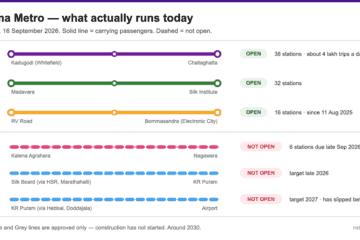
Almost every metro property article in India is written about a line that has not opened. This one is different. The Purple Line is Bengaluru’s original metro corridor, it now runs end to end from Challaghatta in the west to Whitefield and Kadugodi in the east, and it has been carrying passengers along its full length long enough for the property market to have absorbed the news. That changes the analysis completely – you are no longer pricing a promise, you are pricing a service.
This guide sets out where the Purple Line runs, which stretches offer the best value in 2026, how much premium a station is genuinely worth, what has already been priced in, and how to buy near a station without overpaying. It is written for buyers, renters and investors, and all figures are indicative market data that should be verified before you transact.
Where the Purple Line Runs
The corridor stretches roughly 43 kilometres east to west across Bengaluru, operated by Namma Metro. From the western terminus at Challaghatta it runs through Kengeri, Mysore Road and Vijayanagar into Nadaprabhu Kempegowda station at Majestic, which is the interchange with the Green Line. From there it continues east through Cubbon Park, MG Road, Indiranagar and Baiyappanahalli to KR Puram, then on through Mahadevapura, Hoodi and Whitefield to the eastern terminus at Kadugodi.
That alignment is unusually useful because it links three completely different kinds of demand. At the eastern end sit Whitefield, ITPL and the tech campuses. In the middle sit the central business district, MG Road and Indiranagar. At the western end sit the older residential belts around Vijayanagar, Mysore Road and Kengeri. A single ride connects the places people work, the places they go out, and the places they can still afford to live.
For property, the practical consequence is that Purple Line proximity is valuable at almost every point along the corridor, but for different reasons. In the east it is valued as commute infrastructure for tech workers. In the centre it is valued as convenience in already-expensive neighbourhoods. In the west it is valued as the thing that makes a cheaper address viable for someone working across town.
Prices Along the Purple Line Corridor
Prices vary by a factor of four across the corridor, which is why a single “metro premium” figure is meaningless. The table below sets out indicative rates by stretch so that you can see where the value sits rather than where the marketing is loudest.
| Stretch | Rs / sq ft | Why buyers go there |
|---|---|---|
| Indiranagar / MG Road | 16,000-25,000 | Central, established, scarce |
| Whitefield / Kadugodi | 10,500-14,000 | Jobs, malls, schools |
| Baiyappanahalli / Banaswadi | 10,000-14,000 | Near centre, metro-served |
| KR Puram / Kothanur | 6,600-12,150 | Best access-to-price ratio |
| Vijayanagar / Mysore Road | 7,500-11,000 | Established west, good value |
| Kengeri / Challaghatta | 5,500-8,000 | Cheapest metro-served address |
Two stretches stand out on value. The KR Puram and Kothanur belt gives you eastern-corridor access to Whitefield at roughly two-thirds of Whitefield’s price. Kengeri and Challaghatta at the western terminus are the cheapest metro-served addresses in Bengaluru by a clear margin, though the commute east is long even by rail. Both reward buyers who are willing to trade neighbourhood polish for connectivity.
What a Station Is Actually Worth
Metro premiums decay sharply with distance, and the biggest error buyers make is paying a corridor-level premium for a property that is not actually within walking range. The pattern below holds reasonably well across Indian metro corridors and matches what we observe on the Purple Line specifically.
| Walking distance | Rational premium | Comment |
|---|---|---|
| Under 500 m | 8-12% | Genuine walk, rental uplift too |
| 500 m to 1 km | 4-7% | Still walkable for most |
| 1 to 2 km | 1-3% | Depends entirely on feeder transport |
| Over 2 km | Close to zero | Corridor sentiment only |
| Directly under the viaduct | Negative | Noise and privacy penalty |
The last row is the one nobody advertises. An elevated viaduct running past your window is a liability, and lower floors facing the alignment consistently trade below identical units facing away. If you are buying specifically for Purple Line proximity, target close but not adjacent, and check the actual alignment drawing rather than the project’s own map.
What Has Already Been Priced In
Metro corridors reprice in three waves: announcement, visible construction, and commissioning. The largest of the three is commissioning, when the commute genuinely changes. The Purple Line has now passed all three for its full length, and the property market along it has adjusted accordingly. That is the single most important fact for anyone buying here in 2026.
The eastern extension into Whitefield and Kadugodi produced a clear step change in the KR Puram and Mahadevapura belt, where prices have grown roughly 7 to 8 per cent over the past year with much larger cumulative gains across three and five years. The western extension to Challaghatta did something similar for Kengeri and Mysore Road, though from a much lower base. In both cases the easy money has been made.
What remains is the slower, more durable effect: transit-oriented development. Higher permitted density near stations attracts more towers, more residents and more retail, which gradually improves the local economy around each station over a decade. That process is only beginning at most Purple Line stations outside the central stretch, and it is the more realistic basis for expecting further gains than a repeat of the commissioning jump.
The Best Value Stretches in 2026
KR Puram and Kothanur, eastern corridor
This stretch offers the strongest access-to-price ratio on the Purple Line. An average around Rs 9,550 per sq ft buys the same metro line that serves Whitefield at Rs 10,500 to Rs 14,000, plus a suburban railway station and access to three employment poles. Grade-A developer interest is increasing, including a roughly seven-acre pre-launch planned as four G+19 towers with about 500 apartments. Our analysis is on the Prestige Hennur Kothanur project page, and the corridor detail sits in apartments near KR Puram.
Vijayanagar and Mysore Road, western corridor
West Bengaluru is consistently overlooked by buyers focused on the tech belt, which is exactly why it offers value. At Rs 7,500 to Rs 11,000 per sq ft you get established residential neighbourhoods with real social infrastructure, direct Purple Line access to Majestic and the central business district, and considerably less traffic chaos than the eastern corridor. The trade-off is a long ride to the tech campuses.
Kengeri and Challaghatta, western terminus
At Rs 5,500 to Rs 8,000 per sq ft this is the cheapest genuinely metro-served address in Bengaluru. Being at a terminus has a specific advantage – you board an empty train and get a seat, which matters enormously on a fifty-minute ride. It suits buyers whose workplace is in the centre or the west, and it suits patient investors betting on the corridor maturing.
Renting Along the Purple Line
For tenants, the corridor has quietly changed what is possible in Bengaluru. A worker at ITPL no longer has to live in Whitefield; a worker in the central business district no longer has to live in Indiranagar. That flexibility is worth real money, and it is the reason rents near Purple Line stations have held up better than rents a few kilometres away from them.
For landlords, three rules apply consistently along this corridor. Compact two and three-bedroom units near stations let fastest, because the tenant profile is young professionals who value the commute over floor area. Gated projects with reliable water and power outperform standalone buildings, especially on the eastern stretch. And a genuinely walkable route to the station is worth more in monthly rent than an extra hundred square feet of built area, which is not how most owners price their properties.
The Purple Line Against Bengaluru’s Other Corridors
Bengaluru’s metro network is expanding on several axes at once, and the property implications differ sharply depending on which one you are buying near. Understanding where the Purple Line sits in that picture keeps you from paying an operational-line premium for a corridor that is still a construction site.
| Corridor | Axis | Status | Property effect |
|---|---|---|---|
| Purple Line | East to west | Fully operational | Largely priced in |
| Green Line | North to south | Operational | Largely priced in |
| Yellow Line | South, Electronic City | Recently opened | Still adjusting |
| Pink Line | South to north-east | Under construction | Commissioning gain ahead |
| Blue Line | ORR and airport | Under construction | Largest gain still ahead |
Read that table as a trade-off between certainty and upside. Buying near the Purple Line means buying certainty: the service exists, you can test it, and the risk of a delayed opening is zero. Buying near a line still under construction means accepting timeline risk in exchange for a commissioning gain that has not yet happened. Neither is wrong, but they are different investments and should not be priced the same way.
Our view is that for end users the Purple Line is the safer choice by a wide margin, because a home you live in should not depend on an infrastructure project completing. For investors with a long horizon and tolerance for delay, an under-construction corridor may offer more upside – but only if the entry price genuinely reflects the fact that nothing is running yet.
A Worked Example
Take a couple working at ITPL with a Rs 1.6 crore all-in budget who are willing to commute by rail. Buying in Whitefield core at roughly Rs 12,000 per sq ft gives an agreement value near Rs 1.44 crore after costs, which buys about 1,200 sq ft super built-up or roughly 830 sq ft carpet at a 30 per cent loading – a compact three-bedroom home a short drive from work.
The same budget in the KR Puram and Kothanur belt at around Rs 9,800 per sq ft buys about 1,470 sq ft super built-up, or roughly 1,030 sq ft carpet. That is a genuinely larger home, two or three Purple Line stops from the same office, in a rougher neighbourhood. For a household that will actually use the metro, the extra 200 sq ft of carpet is a real gain; for one that will drive, it is a poor trade because the KR Puram junction will eat the difference in time.
This is why we keep returning to the same test. Purple Line property is worth what it is worth to you specifically, and the deciding variable is not the project or even the price – it is whether your household will genuinely change how it travels. Answer that honestly and the corridor decision becomes straightforward.
The Honest Risks
- The commissioning premium is already in the price along most of the Purple Line. Do not model a repeat of the last three years.
- Long end-to-end journey times. Rail is predictable but a Kengeri to Whitefield trip is still a substantial commute.
- Last-mile connectivity is weak at many stations – poor footpaths, inconsistent feeder buses, difficult road crossings.
- Viaduct-adjacent units carry a noise and privacy penalty that shows up at resale.
- Rising density near stations means more construction and more competition for the same trains.
- Corridor quality varies enormously. A station in Indiranagar and one in Kengeri serve completely different markets and should not be valued the same way.
How to Buy Purple Line Property Well
- Fix your workplace first, then choose the stretch that minimises your actual door-to-door time, not your straight-line distance.
- Ride the line at your commuting hour before committing to anything.
- Measure the real walking route to the station, including road crossings and footpath quality.
- Target 500 metres to 1 kilometre from a station; avoid units directly facing the viaduct.
- Verify the project and promoter on the Karnataka RERA portal and read the registered possession date.
- Compare on carpet area per rupee – Bengaluru loading typically runs 28 to 35 per cent.
- Confirm the water source and sewage arrangement, particularly on the eastern stretch.
- Have a Bengaluru property lawyer review the title chain before any substantial payment.
Purple Line Metro Property FAQs
Is the Purple Line fully operational?
Which Purple Line stretch offers the best value?
How much premium should I pay for a flat near a station?
Has the metro gain already been priced in?
Is it better to live near a terminus station?
What is the biggest mistake buyers make on this corridor?
Related Reading
Disclaimer: All rates, premiums, distances and route details in this guide are indicative, drawn from public market data and operator information, and subject to change. Nothing here is an offer, an invitation to invest or professional financial advice. Verify every figure with the developer, Namma Metro, the Karnataka RERA portal and your own legal adviser before you transact. Informational use only.