Kothanur Bangalore Real Estate: The 2026 Guide to Both Kothanurs
Almost every guide to Kothanur real estate makes the same mistake: it treats one name as one place. Bengaluru has two distinct localities called Kothanur, on opposite sides of the city, with different price levels, different employment access, different metro positions and different outlooks. A buyer who reads a price chart for one and views a project in the other will be badly misled, and it happens often enough that brokers rarely bother to correct it.
This guide separates them properly, then goes deep on the eastern one – Kothanur within the KR Puram catchment on the Old Madras Road corridor – because that is where the more interesting 2026 activity sits. It covers what property costs, what drives demand, where the metro fits, what rental yields look like and what an honest risk assessment says. Every figure is indicative market data and should be verified before you transact.
First, Which Kothanur Do You Mean?
The northern Kothanur sits off Hennur Road and Bagalur Road, in the belt that feeds Manyata Tech Park and runs towards Kempegowda International Airport. It is a quieter, more residential pocket with a large share of independent houses, plotted layouts and mid-sized apartment projects, and it has historically been one of the more affordable parts of North Bengaluru.
The eastern Kothanur lies within the KR Puram catchment on the Old Madras Road spine, inside the arc that connects Whitefield to Hebbal via the Outer Ring Road. This is a busier, more commercial corridor with heavier traffic, an operating metro station nearby, a suburban railway station and direct access to two major employment poles. It is the one attracting Grade-A developer interest in 2026.
| Factor | Kothanur (East, KR Puram) | Kothanur (North, Hennur) |
|---|---|---|
| Corridor | Old Madras Road | Hennur / Bagalur Road |
| Metro | Purple Line, operational | Not yet operational |
| Main employment | Whitefield, ORR, Manyata | Manyata, airport belt |
| Character | Busy, commercial, connected | Quieter, residential |
| Rail | KR Puram station nearby | None close |
Kothanur and KR Puram Property Rates in 2026
Flats in the KR Puram catchment that contains eastern Kothanur broadly transact between Rs 6,600 and Rs 12,150 per sq ft, with an average around Rs 9,550. In the northern Kothanur near Hennur Road, average flat rates sit lower, in the region of Rs 8,300 per sq ft, with a good deal of stock priced between Rs 6,000 and Rs 7,000 in older or smaller-builder projects. Those two averages are why getting the locality right matters financially, not just geographically.
| Stock type | Rs / sq ft | Comment |
|---|---|---|
| Small-builder resale, east | 6,600-8,000 | Check approvals carefully |
| KR Puram catchment average | About 9,550 | Mixed gated and standalone |
| Grade-A gated, east | 10,000-12,150 | Top of the current market |
| Kothanur north average | About 8,300 | Quieter, cheaper, no metro |
| Whitefield core comparison | 10,500-14,000 | Same metro line, higher price |
The eastern corridor has grown roughly 7 to 8 per cent over the past year, with much larger cumulative gains over three and five years as the Purple Line moved from construction to service. That pattern – a step change around metro commissioning followed by steadier growth – is exactly what transit corridors do, and it is the single most useful thing to understand about Kothanur real estate on this side of the city.
What Drives Demand in Eastern Kothanur
Three employment poles sit within reach, which is unusual. Whitefield and ITPL lie eight to twelve kilometres east and are directly served by the same metro line. The Outer Ring Road corridor towards Marathahalli and Bellandur is nine to thirteen kilometres south. Manyata Tech Park and the north-eastern office cluster are reachable via the ORR to the north-west. A tenant or buyer here is not dependent on one employer or even one district.
Layered on top is the price gap with Whitefield. As Whitefield core pushed towards Rs 10,500 to Rs 14,000 per sq ft, demand spilled westwards along the same metro line into KR Puram and Kothanur, where the same commute could be bought for less. That substitution effect is the main engine of the corridor’s recent growth, and it will continue as long as the price gap persists.
The third driver is developer attention. Grade-A builders have begun assembling parcels here, including a roughly seven-acre pre-launch by Prestige Estates Projects planned as four G+19 towers with about 500 apartments. Our full analysis of that development sits on the Prestige Hennur Kothanur project page. Branded supply tends to lift the whole corridor’s benchmark, which benefits existing owners.
Connectivity: The Corridor’s Real Asset
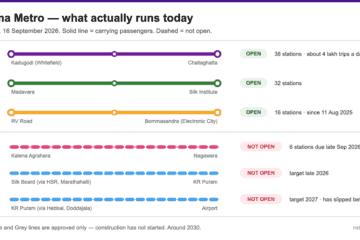
Eastern Kothanur has something almost no other Bengaluru residential locality can claim: an operating metro line and a suburban railway station. The Namma Metro Purple Line serves KR Puram and runs east to Whitefield and Kadugodi and west to MG Road, Majestic and Challaghatta. KR Puram railway station adds long-distance and suburban rail. Together they make this a genuine rail-served address rather than a car-dependent one.
Road access is a more mixed story. Old Madras Road and NH-75 give a clean run eastwards towards Hoskote and Kolar, and the Outer Ring Road connects north-west to Hebbal and south to Marathahalli. But the KR Puram junction itself is one of the more congested points in the city, and the ORR stretch towards Marathahalli is notoriously slow at peak. A household that drives everywhere will find this corridor frustrating; one that uses the metro will find it excellent.
- Purple Line metro at KR Puram – operational, running east to Whitefield and west to the CBD
- KR Puram railway station – suburban and long-distance services within the immediate area
- Old Madras Road and NH-75 for the eastern exit
- Outer Ring Road for Manyata to the north-west and Marathahalli to the south
- Kempegowda International Airport roughly 36 to 42 kilometres, typically 60 to 90 minutes
Rental Yields and the Investor View
Gross rental yields in the eastern Kothanur and KR Puram catchment typically run about 3 to 3.8 per cent, which is good by Bengaluru standards where 2.8 to 3.5 per cent is more common in the premium corridors. Two things support that. Entry prices are lower than Whitefield while rents are not proportionally lower, and the tenant pool draws from three employment poles rather than one.
For a landlord, the practical guidance is consistent with the rest of Bengaluru. Two and three-bedroom units let fastest and resell to the widest pool. Proximity to the metro station is worth more in monthly rent than an extra 100 sq ft. Gated projects with reliable water, power backup and security command a clear premium over standalone buildings in this corridor, because the surrounding public realm is weak enough that residents value the boundary wall.
| Metric | Indicative | Reading |
|---|---|---|
| Gross yield | 3-3.8% | Above Bengaluru premium average |
| 1-year price change | About 7-8% | Metro-supported, steady |
| Employment poles | Three | Whitefield, ORR, Manyata |
| Best letting size | 2 and 3 BHK | Widest tenant and buyer pool |
| Realistic hold | 5-8 years | To clear costs and taxes |
Schools, Hospitals and Everyday Life
Social infrastructure in the eastern Kothanur corridor is mature rather than emerging, which is a genuine advantage over the outer growth nodes where buyers pay today for facilities promised later. Schools within a practical radius include Vibgyor High, National Public School, Gopalan International, New Horizon Public School and Sri Chaitanya, spanning CBSE, ICSE and state boards.
Healthcare includes Manipal and Columbia Asia towards Whitefield, Vydehi Institute, Sakra World Hospital on the Outer Ring Road and several multi-speciality options nearer KR Puram itself. Retail runs to Phoenix Marketcity and Nexus Shantiniketan on the Whitefield side and Orion East Mall at Banaswadi, alongside dense local market activity around KR Puram. Everything a household needs exists and operates; what is missing is polish.
What Is Being Built in Kothanur
Supply in the eastern Kothanur corridor has historically come from small and mid-sized builders working on one and two-acre parcels, which is why the stock is so varied in quality and why approval paperwork needs closer scrutiny here than in a master-planned district. Buildings from the 2000s sit next to recent gated projects, and the gap in specification, water arrangement and society management between them is wide.
What has changed recently is the arrival of larger developers assembling bigger parcels. A roughly seven-acre pre-launch by Prestige Estates Projects, planned as four G+19 towers with about 500 apartments in 2, 3 and 4 BHK formats and an indicative October 2030 possession, is the most visible example. At around 71 units per acre that is a moderate density by Bengaluru standards, which usually translates into real open space rather than a podium strip.
Branded supply changes a corridor in three ways that matter to an existing owner. It lifts the local price benchmark, because a Grade-A launch establishes a new top of market. It raises the amenity standard that buyers expect, which can make older stock look dated. And it improves liquidity, because more buyers search the locality once a recognised name is there. On balance it is good news for owners and a mixed blessing for new buyers, who pay the higher benchmark.
Which Kothanur Suits Which Buyer
| If you | Choose |
|---|---|
| Work in Whitefield or ITPL | Eastern Kothanur – same metro line, lower price |
| Work at Manyata Tech Park | Northern Kothanur – shorter, simpler drive |
| Travel often by air | Northern Kothanur – far better airport access |
| Want to avoid owning a car | Eastern Kothanur – metro plus railway station |
| Want a quiet residential street | Northern Kothanur – calmer, more residential |
| Are buying primarily to let | Eastern Kothanur – three employment poles |
That table is the practical output of this whole guide. Once you know which employment pole anchors your household and whether you intend to use rail, the choice between the two Kothanurs answers itself – and it answers differently for different people, which is precisely why a single ranked list of “best areas” is useless here.
One final piece of advice. Whichever side you choose, visit at 9 am on a weekday and again at 7 pm before you commit. Both Kothanurs feel entirely different at peak from how they feel on a Sunday afternoon site visit, and the corridor you will actually live in is the peak-hour one. No amount of research substitutes for standing at the junction and watching it.
The Honest Risks
- Name confusion. Two Kothanurs in one city with a several-thousand-rupee price gap is a genuine transactional risk, not a curiosity.
- KR Puram junction congestion is severe and structural, and no project can fix it.
- Weak public realm. Inconsistent footpaths, heavy commercial traffic on Old Madras Road, limited greenery.
- Approval quality varies. The corridor has a long tail of small-builder stock where plan sanctions, khata and conversion documents need careful checking.
- Water supply. Confirm the Cauvery connection status or borewell position for any specific project – this is a persistent East Bengaluru issue.
- Post-metro pricing. Much of the commissioning gain has already been captured; do not assume the last three years repeat.
How to Buy Well in Kothanur
- Establish which Kothanur you are dealing with using the survey number and PIN code before anything else.
- Verify the project and promoter yourself on the Karnataka RERA portal and read the registered possession date.
- Check the khata classification, the plan sanction and any land conversion order, particularly on smaller projects.
- Measure the real walking route to the Namma Metro Purple Line station rather than the straight-line distance.
- Compare options on carpet area per rupee – Bengaluru loading typically runs 28 to 35 per cent.
- Confirm the water source and sewage treatment arrangement in writing.
- Have a Bengaluru property lawyer review the title chain and the agreement before any substantial payment.
Kothanur Bangalore Real Estate FAQs
Why are there two Kothanurs in Bangalore?
What is the property rate in Kothanur in 2026?
Is Kothanur a good place to invest?
Does Kothanur have metro connectivity?
How does Kothanur compare with Whitefield?
What should I check before buying here?
Related Reading
Disclaimer: All rates, yields, distances and timelines in this guide are indicative, drawn from public market data, and subject to change. Nothing here is an offer, an invitation to invest or professional financial advice. Verify every figure with the developer, the Karnataka RERA portal and your own legal adviser before you transact. Informational use only.