Whitefield Real Estate: 9 Smart, Proven Facts 2026

Whitefield real estate is one of the few Bangalore stories that has run in a straight line for two decades: more jobs, more people, more homes, higher prices. What began as a sleepy Anglo-Indian settlement on the eastern edge of the city is now a dense, self-contained tech township with its own malls, hospitals, international schools, and – since 2023 – a direct metro line to the central business district. For anyone weighing where to buy in East Bangalore, understanding how Whitefield real estate got here explains a lot about where it is going next.
This is a market analysis, not a sales pitch. We will trace Whitefield’s arc from cantonment to tech hub, map the job engine that underpins demand, look honestly at price appreciation and rental yields, and weigh the real risks. Along the way we will use one current new launch – Arvind ITPL on ITPL Main Road – as a live example of how developers are positioning fresh supply into this corridor. The goal is to help you judge Whitefield real estate on the numbers and the trade-offs, not the hype.
How Whitefield Real Estate Grew From Cantonment Village to Tech Township
Whitefield was founded in the 1880s as a settlement for the Eurasian and Anglo-Indian community, a green pocket of bungalows and orchards well outside old Bangalore. For a century it stayed rural. The turning point was 1994-1998, when the International Tech Park Bangalore (ITPL) opened on what is now ITPL Main Road. ITPL was one of India’s first world-class IT campuses, and it pulled the software industry eastward almost overnight. The EPIP (Export Promotion Industrial Park) Zone and later the Whitefield SEZ layered more office space on top, and by the mid-2000s the area had become a magnet for IT/ITES employers and, more recently, global capability centres (GCCs) run by multinational banks and product firms.
That employment base is the single most important fact about Whitefield real estate. Homes here are not bought on sentiment; they are bought by the hundreds of thousands of engineers, analysts, and managers who need to live within a reasonable commute of ITPL, EPIP, and the SEZ clusters. When a corridor manufactures its own tenants and buyers at that scale, housing demand becomes structural rather than speculative – and that is the foundation the rest of this analysis rests on.
The Job Engine Behind Whitefield Real Estate
Demand for Whitefield real estate is best understood as a function of desks. ITPL alone houses a large cluster of IT and back-office employers; the EPIP Zone and Whitefield SEZ add many more; and a steady stream of GCCs has chosen East Bangalore over the traditional CBD because floor plates are larger and rents are lower. Every new office lease in this belt translates, over a couple of years, into fresh demand for rental flats and eventually for owned homes as employees put down roots.
This is also why Whitefield real estate is comparatively resilient during slowdowns. When one sector wobbles, another – fintech, semiconductor design, biotech, e-commerce logistics – is usually hiring. The tenant pool is deep and diversified, which keeps vacancy low and rent collection steady. For a landlord, a diversified employer base is worth more than any single glossy amenity, because it protects the rent through the cycle.
The Purple Line Changed the Whitefield Real Estate Math
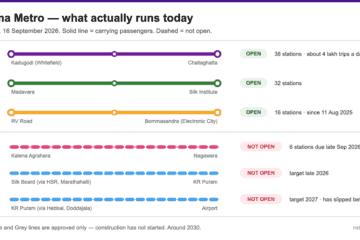
For years, the one genuine weakness in the Whitefield real estate case was connectivity: the corridor was jobs-rich but road-locked, and the commute to MG Road or Indiranagar in peak traffic was punishing. That changed in 2023 when the Namma Metro Purple Line extension to Whitefield (Kadugodi) became operational. This is live infrastructure, not a promise on a brochure – trains now run from Whitefield straight into the central business district, cutting a formerly hour-plus road slog to a predictable rail ride.
The metro did two things to Whitefield real estate. First, it widened the buyer pool: a professional working in the CBD can now realistically live in Whitefield and reverse-commute by train, and vice versa. Second, it re-rated flats within walking or short-feeder distance of the Purple Line stations, because metro-adjacency is one of the most durable price premiums in any Indian city. Projects along ITPL Main Road and the Whitefield spine captured much of that Whitefield real estate uplift.
Whitefield Real Estate Price Appreciation and Rental Yields
Over the long run Whitefield real estate has delivered steady capital appreciation, punctuated by the sharp post-2021 run-up that hit most of Bangalore. New-launch Whitefield real estate pricing on ITPL Main Road today sits at a clear premium to the resale stock of a decade ago, reflecting the metro, the maturing social infrastructure, and constrained land near the tech parks. The table below sets out indicative ranges – treat every figure as an estimate to confirm in writing, never a quote.
| Whitefield real estate metric | Indicative range (verify) |
|---|---|
| New-launch price band | Premium to older resale stock |
| Gross rental yield | Roughly 3% to 4% typical |
| Primary demand driver | ITPL / EPIP / SEZ jobs |
| Key connectivity upgrade | Purple Line metro (live) |
Rental yields in Whitefield real estate typically land in the 3% to 4% gross range – modest on paper, but that number understates the case because it ignores appreciation and the near-certainty of finding a tenant. In a corridor with this much employment density, the practical risk of a flat sitting empty is low, and that occupancy reliability is itself a form of return that pure yield math misses.
Supply: New Launches and Arvind ITPL
Land near the tech parks is finite, so new supply in Whitefield real estate increasingly means high-rise redevelopment on the few remaining sizeable parcels along ITPL Main Road and the Whitefield spine. One current example is Arvind ITPL, a new-launch high-rise on ITPL Main Road, developed by Arvind SmartSpaces – the listed real-estate arm of the Lalbhai / Arvind Limited group. It is a useful lens on how developers are reading Whitefield real estate demand in this corridor.
Arvind ITPL is planned across roughly 9 acres with about 4.2 lakh sq ft of saleable area and an estimated revenue potential near Rs 600 crore, offering 2 and 3 BHK apartments with 37-plus amenities, a large clubhouse, and a deliberately low-density layout. Arvind SmartSpaces entered Bengaluru in 2013 and has since launched around 13 projects with 6 delivered, several of them Whitefield and ITPL Road high-rises – so the Whitefield real estate track record in this micro-market is real. Its positioning – low density, amenity-heavy, walkable to the tech parks – is exactly the template Whitefield real estate buyers now expect from a premium launch.
Social Infrastructure That Locks In Whitefield Real Estate Demand
Whitefield real estate benefits from social infrastructure that most Bangalore suburbs took decades longer to build. Families relocating for a tech job find international and CBSE schools – Whitefield Global, Vibgyor, Deens Academy, Gopalan – within the corridor. Healthcare is anchored by Manipal, Vydehi, and Sathya Sai hospitals. And for retail and weekends, Phoenix Marketcity, VR Bengaluru, Forum Shantiniketan, and Nexus Whitefield mean residents rarely need to leave the eastern side of the city.
This self-sufficiency is a quiet but powerful driver of Whitefield real estate values. A household that can work, school its children, see a doctor, and shop all within a few kilometres has little reason to move away – which keeps resale liquidity healthy and rental churn manageable. Mature social infrastructure is precisely what separates a durable residential market from a speculative one.
Future Infrastructure: Roads and the Peripheral Ring Road
Beyond the metro, the road network shapes Whitefield real estate too. The area is served by ITPL Main Road, Whitefield Main Road, the Outer Ring Road (ORR), Old Madras Road, and Varthur Road. The most-watched future project is the long-planned Peripheral Ring Road (PRR), which is intended to loop around the city and give East Bangalore a faster orbital connection to the airport and the northern and southern corridors without funnelling everything through the congested core.
If the PRR is delivered on anything like its stated alignment, it would meaningfully improve Whitefield real estate by cutting airport and cross-city travel times – a genuine value driver for a corridor whose one persistent complaint is road congestion. That said, treat the PRR as upside, not as a reason to buy: large ring-road projects in India routinely slip by years, and you should never pay today for infrastructure that has not broken ground.
The Honest Risks in Whitefield Real Estate
No corridor is a one-way bet, and Whitefield real estate carries specific risks worth naming plainly:
- Pre-RERA new launches. Buying a project before RERA registration is finalised means you are trusting the developer’s track record ahead of a registered plan. Wait for the RERA number.
- Possession years out. A new high-rise can be three to four years from handover. Your money is committed while the corridor – and your own life – keeps changing.
- Premium pricing. New-launch rates on ITPL Main Road already price in the metro and the tech-park proximity, so the easy appreciation may be behind, not ahead.
- Traffic. Despite the Purple Line, ORR and Whitefield Main Road congestion at peak hours remains real and can dent both livability and rental appeal.
- Supply overhang. Several developers are launching into the same corridor at once, which can cap short-term price growth and lengthen resale timelines.
None of these is a reason to avoid Whitefield real estate outright; the fundamentals remain among Bangalore’s strongest. They are reasons to buy carefully – verify the RERA status, stress-test your holding period, and pay for what exists today rather than for a brochure. You can independently confirm any project’s registration on the Karnataka RERA portal before committing.
The Verdict on Whitefield Real Estate
The case for Whitefield real estate in 2026 is a case for structural demand. A vast, diversified employment base at ITPL, EPIP, and the SEZ clusters manufactures its own tenants and buyers; an operational Purple Line has removed the corridor’s biggest historic weakness; and mature social infrastructure keeps residents rooted. Add a credible pipeline of premium new launches feeding into it, and the Whitefield real estate picture is one of real depth rather than froth. For a buyer with a genuine East Bangalore need and a multi-year horizon, Whitefield real estate remains a rational, defensible choice.
The Whitefield real estate discipline is in the execution: buy near jobs and the metro, insist on RERA and written terms, and be honest with yourself about premium entry prices and the possibility of near-term supply overhang. Do that, and Whitefield real estate rewards patience about as reliably as any corridor in the city.
Whitefield Real Estate FAQ
Is Whitefield real estate still a good investment in 2026?
Is the Whitefield metro actually running?
What rental yield can I expect in Whitefield?
What is Arvind ITPL and where is it?
What are the biggest risks in Whitefield real estate right now?
Will the Peripheral Ring Road help Whitefield?
Related Reading
Disclaimer: All prices, yields, areas, and project details above are indicative and estimated for information only, and may change without notice. Arvind ITPL is a pre-launch; verify RERA registration, sanctioned plans, and possession dates in writing with Arvind SmartSpaces / Karnataka RERA before purchase. This article is informational only and is not an offer, solicitation, or investment advice.