Rental Yield Near Bangalore Airport: An Investor’s Guide for 2026
If you are buying property as an investment, rental yield near Bangalore airport is one number you must understand before you commit.
It tells you how hard your money works each year through rent, and it sets realistic expectations for cash flow during the holding period.
This guide explains rental yield near Bangalore airport in plain terms — what it is today, why it sits where it does, and how it could improve.
Many first-time investors are surprised by how low Indian rental yields are. Setting the right expectation early prevents disappointment and poor decisions later.
What Rental Yield Actually Means
Rental yield is simply your annual rent as a percentage of the property’s cost. Earn ₹2.5 lakh a year on an ₹85 lakh home and the gross yield is roughly 3%.
Gross yield ignores costs. Net yield — after maintenance, property tax, vacancy and repairs — is the figure that matters to your pocket.
For the airport corridor, you should read every yield number with that distinction in mind. The headline rarely tells the full story.
Yield also lets you compare a property against other assets — a fixed deposit, a bond or equity. Seen that way, rent is only one part of a property’s total return.
Current Rental Yield Near Bangalore Airport
In 2026, gross rental yield near Bangalore airport typically sits in the 2.8–3.5% band. That is in line with most Bangalore residential markets.
In rupee terms, a 2 BHK in the corridor rents for roughly ₹18,000–24,000 a month. A 3 BHK commands more, though the yield percentage is often similar.
| Unit | Indicative Rent | Gross Yield |
|---|---|---|
| 2 BHK | ₹18,000–24,000 | 2.8–3.5% |
| 3 BHK | ₹26,000–36,000 | 2.8–3.3% |
| Net yield | After costs | Roughly 2–2.7% |
A Worked Yield Example
Take a 2 BHK bought at ₹85 lakh that rents at ₹22,000 a month. Annual rent is ₹2.64 lakh, so the gross yield works out to about 3.1%.
Now subtract the running costs. Maintenance, property tax, one vacant month and minor repairs might take ₹55,000–65,000 off that figure in a typical year.
Net rent then sits near ₹2 lakh, a net yield of roughly 2.4%. That gap between gross and net is exactly why honest budgeting matters.
Change the rent or the price and the percentage shifts, but the method stays the same — always run the numbers on your own figures, not the brochure’s.
Who Rents in the Airport Corridor
The tenant pool is a key part of rental yield near Bangalore airport. Demand comes mainly from aviation and logistics staff working at the airport.
Add IT professionals at the KIADB Aerospace Park and nearby tech hubs, plus corporate employees who want a shorter northern commute.
This is a stable, salaried tenant base. That matters: dependable tenants mean fewer vacancy gaps, which directly protects your effective rental yield near Bangalore airport.
This tenant mix is also fairly recession-resistant. Aviation and essential-services jobs tend to hold up better than discretionary sectors, which adds a layer of stability to corridor rents.
Why Yields Are Modest Right Now
Rental yield near Bangalore airport is modest today for a clear reason: the corridor is still in its build-out phase.
Many projects are under construction, so the rental supply will rise. At the same time, the metro and several offices are not yet fully operational, so demand has not peaked.
There is also a structural point: across India, residential yields are generally low. Real estate returns here have always leaned on appreciation rather than rent.
None of this makes the corridor a weak buy. It simply means rent is the supporting actor, not the lead, in the return you should plan around.
How Yields Could Improve
The outlook for rental yield near Bangalore airport is genuinely positive over a multi-year view.
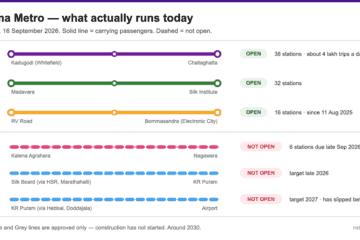
When the Namma Metro airport line opens, the corridor becomes far more attractive to tenants, pushing rents up.
As the Devanahalli Business Park and Aerospace Park add jobs, the tenant pool deepens. More demand against a fixed home cost lifts the yield over time.
Gross Versus Net: The Real Number
When an agent quotes rental yield near Bangalore airport, they usually mean gross yield. Your actual return is net.
Subtract maintenance charges, property tax, the cost of one or two vacant months, periodic repairs and any management fee. Net yield usually lands around 2–2.7%.
This is not a reason to avoid the corridor — it is a reason to budget honestly and treat appreciation as the main return.
How the Corridor Compares
It helps to see the corridor in context. Established Bangalore suburbs such as Whitefield, Sarjapur Road and Hebbal also deliver gross yields in a broadly similar 3% band.
In other words, the airport belt is not an outlier on rent. Where it differs is on price — a lower entry cost leaves more room for both yield and capital growth to climb.
That is the investor’s edge here: buy cheaper today, and let the corridor catch up to the city on both measures.
The risk, of course, is that heavy supply delays that catch-up. Picking a strong project in a well-located pocket is how you stay on the right side of it.
Tips to Maximise Your Yield
Buy at launch pricing. A lower entry cost directly raises the rental yield near Bangalore airport that you can achieve later.
Choose a project close to the metro and job hubs, and a 2 BHK for the widest tenant pool. Verify it on the Karnataka RERA portal.
Keep the home well maintained to reduce vacancy, and see our Mahindra Navaratna listing and airport investment guide for the full picture.
Furnishing can lift rent too. A well-finished, semi-furnished home often commands a premium and attracts longer-staying corporate tenants, which trims vacancy and steadies your income.
Frequently Asked Questions
What is the rental yield near Bangalore airport in 2026?
Why is the yield relatively low?
Will rental yield improve in the future?
Which unit gives the best yield?
Related Reading
Disclaimer: Rental figures and yield ranges are indicative 2026 estimates and vary by project, floor and furnishing. This is general guidance, not financial advice. Verify details with developers and the Karnataka RERA portal before investing.