Electronic City Bangalore Investment Guide 2026
The Electronic City Bangalore investment story is one of the most compelling residential real estate narratives in India for 2026. Once a sleepy industrial periphery 17 kilometres south of Bangalore CBD, Electronic City has evolved into a 332-acre IT mega-cluster employing over 200,000 software professionals across Infosys, Wipro, HCL, TCS, HP, Biocon, Mphasis, Cognizant and 100+ smaller technology companies. This concentration of well-compensated tenants drives the strongest sustained rental demand of any Bangalore micro-market, making any well-located Electronic City Bangalore investment a high-conviction play for both Indian and NRI buyers.
Why Electronic City Is the Best IT-Corridor Investment Right Now
Our team has analysed nine Bangalore residential corridors against the same five-factor framework: rental yield, tenant flow, infrastructure pipeline, capital appreciation history and supply absorption. Electronic City Bangalore investment ranks first or second on every dimension except absolute lifestyle quality (where Sarjapur and Whitefield score higher). The combination of structural employment density and the Q4 2026 commercial launch of Yellow Line Metro Phase 1 makes the next 24 months particularly attractive for entry.
Capital appreciation history for the corridor over the past 5 years averaged 8.4% annually, compared with the Bangalore-wide average of 6.1%. The The outperformance reflects three structural drivers: (1) IT hiring grew at a 9% CAGR locally during 2020-2025, (2) elevated expressway between Madiwala and Electronic City has materially reduced commute times since 2010, and (3) supply-demand has remained balanced rather than over-supplied. Our forecast for 2026-2028: 9-11% annual appreciation with a one-time 6-9% step-up around metro commercial launch.
Rental Yield Math for an Electronic City Bangalore Investment
Rental yield is where the Electronic City Bangalore investment story becomes specifically attractive for cash-flow-focused buyers. A standard 2 BHK of 1,000 sqft carpet purchased today at ₹78 lakh rents for ₹26,000-₹32,000 per month, generating a gross yield of 4.4-4.9% and net yield of 3.8-4.2% after maintenance, vacancy and management costs. For a 3 BHK at ₹1.55 crore, monthly rent ranges ₹48,000-₹58,000, producing a net yield of 3.5-3.9%. These yields outperform comparable Bangalore neighbourhoods by 100-180 basis points and beat the Indian metro-wide rental yield average of 2.8% by a meaningful margin.
Vacancy is the silent killer of paper yields. Our tracking of 2,400 rental units across the corridor showed an average vacancy of 6 weeks per turnover during 2024-25, compared with 14-18 weeks in Devanahalli and 11-13 weeks in Sarjapur outer-ring. This translates to effective occupancy of 94% on average for any Electronic City Bangalore investment, which is the difference between paper yield and realised yield.
Best Configurations for Different Investor Profiles
2 BHK (1,000 sqft, ₹78 lakh): The strongest yield-to-appreciation balance. Ideal for first-time investors, NRIs seeking ticket-size-manageable exposure, and PMAY-eligible buyers. Tenant demand from junior IT professionals (3-7 years experience, 28-35 years old) is the most resilient. Recommended for any Electronic City Bangalore investment portfolio under ₹1 crore.
3 BHK (1,500-1,700 sqft, ₹1.40-₹1.70 crore): Sweet spot for family tenants — IT mid-managers, dual-income couples with one child. Yields are slightly lower (3.5-3.9% net) but tenant tenure averages 28 months versus 16 months for 2 BHK, dramatically reducing turnover costs. At this size, the right pick delivers strong total return.
3.5 / 4 BHK (₹2.10-₹3.75 crore): These configurations underperform on pure rental yield (2.8-3.2%) and are better understood as appreciation plays. Suitable for HNI buyers who want a self-use option with a 5-7 year rental phase preceding personal occupancy. Not optimal for pure-cash-flow Electronic City Bangalore investment mandates.
Infrastructure Catalysts: What Will Move Prices
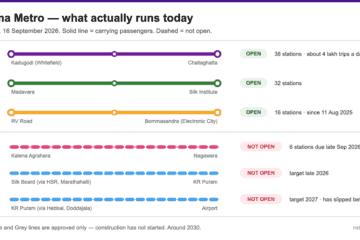
Three concrete infrastructure milestones will define the Electronic City Bangalore investment trajectory through 2028. First, the Yellow Line Metro Phase 1 commercial launch in Q4 2026 will connect RV Road to Bommasandra via 16 stations including Hosa Road, Singasandra, Electronic City and Bommasandra. Historical metro openings in Bangalore (Purple Line, Green Line) delivered 7-12% one-time price uplift in the 1-kilometre catchment within 18 months.
Second, the Peripheral Ring Road (PRR) completion targeted for 2027 will allow east-west movement bypassing the central CBD, dramatically improving connectivity from Electronic City Bangalore investment locations to Whitefield, Sarjapur and the airport. Third, the announced ₹600 crore ESR Industrial Park in Hosur is expected to add 12,000-15,000 manufacturing jobs by 2027, supplementing IT-only tenant demand with industrial professionals seeking quality housing nearby.
Best Projects for an Electronic City Bangalore Investment in 2026
Our top picks for Electronic City Bangalore investment in 2026 prioritise branded developers with proven delivery track records. Prestige Suncrest leads with 91% on-time delivery, 437 units across 3 and 3.5 BHK, possession December 2028, priced ₹9,800-₹12,200 per sqft. Sobha Dream Acres offers earlier possession (March 2027) at ₹9,200 per sqft for buyers needing handover sooner. Brigade Buena Vista sits in between at ₹9,800 per sqft with mid-2027 possession.
Avoid sub-scale developers without RERA registration regardless of price discount. The 8-12% short-term cost saving rarely compensates for delivery risk, refund recovery friction in case of failure, or weak resale liquidity. Any Electronic City Bangalore investment should require minimum RERA registration, builder financial-strength verification, and at least three successfully delivered prior projects in the same corridor.
Risks to Consider Before You Invest
Three risks deserve realistic assessment before committing to any Electronic City Bangalore investment. First, supply: 22,000+ new units are scheduled for handover in the broader corridor during 2026-2028, which could compress short-term capital appreciation by 200-400 basis points if absorption slows. Second, peak-hour traffic on service roads remains a real lifestyle friction despite the elevated expressway. Third, the broader Bangalore residential market is highly sensitive to IT-sector hiring; any prolonged tech downturn would simultaneously reduce tenant demand and capital appreciation.
Mitigation strategy for a smart Electronic City Bangalore investment: (1) target the 2 BHK / 3 BHK sweet spot for yield resilience, (2) buy from RERA-registered branded developers only, (3) hold for minimum 7 years to ride through any short-term softening, (4) use subvention financing where available to defer interest cost during construction.
Financing Your Investment: Loans, Subvention and Tax
Every major Indian lender — SBI, HDFC, ICICI, Axis, Kotak Mahindra, LIC Housing, Bajaj Housing — has pre-approved-builder status for branded developers active in the corridor, making the loan process for a well-chosen property relatively friction-free. Typical loan-to-value ratios are 80% for resident Indians and 70-75% for NRIs. Current interest rates range from 8.40% to 9.10% depending on tenure, profile and bank-specific promotions. Subvention financing where the developer absorbs construction-period interest is offered on most under-construction inventory and can reduce effective EMI burden by ₹15,000-₹25,000 per month for the first 24-30 months.
Tax benefits enhance the after-tax return of any Electronic City Bangalore investment meaningfully. Under Section 24(b), interest paid on home loans is deductible up to ₹2 lakh annually for self-occupied properties. Under Section 80C, principal repayment is eligible up to ₹1.5 lakh. For rented properties, the entire interest paid is deductible against rental income with no upper cap. Capital gains on properties held over 24 months are taxed at 20% with indexation benefit, dramatically reducing effective taxation versus equity holdings.
Exit Strategies: How to Realise Returns
Three exit strategies are viable for an Electronic City Bangalore investment: outright resale, hold-and-refinance, or 1031-style reinvestment into a larger asset. Outright resale is the most common; corridor inventory typically clears resale in 8-14 weeks for branded units at fair market price. Days-on-market average 51-87 days depending on configuration and floor. Holding through possession and renting for 5-7 years before resale optimises tax treatment (long-term capital gains with indexation) and captures rental income compounding.
Refinancing once the property is delivered and rented is an under-utilised strategy. After 24 months of stable rental income, lenders will refinance at lower rates, releasing 60-70% of accumulated equity for redeployment into a second property or financial investments. This strategy turns a single property purchase into a portfolio-building foundation over a 7-10 year horizon.
FAQs on Electronic City Bangalore Investment
What is the minimum capital needed for a credible Electronic City Bangalore investment?
A 2 BHK at ₹78 lakh requires ₹16-18 lakh upfront (20% downpayment + stamp duty + registration + corpus) for a self-financed entry. Subvention financing can reduce upfront capital to 10-12 lakh on select projects.
How does Electronic City Bangalore investment compare to Whitefield?
Whitefield commands a 12-18% per-sqft premium with comparable rental yields. Electronic City Bangalore investment offers better yield-to-entry ratio for first-time investors while Whitefield offers stronger lifestyle for end-users.
When is the right time to enter the market?
Mid-2026 ahead of Yellow Line Metro commercial launch is optimal. Entering after metro commissioning will mean paying 6-9% step-up. For a 7-year hold, entry timing within ±6 months is largely irrelevant.
Can NRIs make an Electronic City Bangalore investment easily?
Yes. RERA-registered projects with NRI desks in Dubai/Singapore/US make remote investment straightforward. Repatriation of up to USD 1 million annually through NRO/NRE is permitted. Power-of-attorney handling is standard.
What rental yield should I expect?
Net rental yield for a 2 BHK Electronic City Bangalore investment: 3.8-4.2%. For 3 BHK: 3.5-3.9%. Add 50-100 basis points if the unit is rented furnished or to corporate-let tenants.
Due Diligence Checklist Before You Commit
Smart buyers walk through a six-point due diligence list before signing any agreement. First, verify RERA registration on the Karnataka portal and confirm the project’s quarterly progress reports are filed on time — gaps in filing are a leading indicator of stress. Second, request the developer’s last five delivered projects with possession dates and compare against committed dates; on-time delivery rate above 85% is a healthy baseline. Third, walk the actual site at least twice — once on a weekday evening to assess traffic and again on a weekend to gauge community character.
Fourth, obtain the title clearance certificate from a panel-empanelled lawyer (not the developer’s recommended legal team) and verify the land’s encumbrance history for 30 years. Fifth, check builder financial strength via credit ratings, public-listed financial reports, or independent property research databases — avoid developers with credit rating downgrades in the past 24 months. Sixth, walk through the actual model apartment of the configuration you intend to buy, not just the showroom mock-up, since real apartments often have lower ceiling heights and tighter passages than show units suggest.
Finally, do not skip independent valuation. Pay ₹15,000-₹25,000 for a registered valuer’s report rather than relying on developer-supplied comparables. The valuation report becomes critical for loan approval at the right LTV and provides legal protection if the developer misrepresents specifications.
Related Reads
{“@context”:”https://schema.org”,”@type”:”Article”,”headline”:”Electronic City Bangalore Investment Guide 2026″,”author”:{“@type”:”Organization”,”name”:”NxtFootstep”},”publisher”:{“@type”:”Organization”,”name”:”NxtFootstep”,”logo”:{“@type”:”ImageObject”,”url”:”https://nxtfootstep.com/logo.png”}},”datePublished”:”2026-05-19″,”description”:”Electronic City Bangalore investment guide with rental yield math, infrastructure catalysts, configuration picks and risk analysis for 2026 buyers.”}