Whitefield Real Estate Guide 2026: Why East Bangalore’s IT Hub Still Wins for Homebuyers
Whitefield has gone from a quiet settlement to the beating heart of East Bangalore’s technology economy, and in 2026 it remains one of the smartest places to buy a home if you work in the city’s eastern tech corridor. This guide covers what living in the area actually involves – the commute, schools, healthcare, lifestyle and the property market – so you can decide whether it fits your family before you buy. If you are evaluating a specific project, our detailed Sobha Windsor Phase 2 buyer guide pairs naturally with this Whitefield overview.
Why Whitefield Still Wins
Whitefield’s foundation is jobs. Anchored by ITPL, the EPIP Zone and a dense cluster of technology parks, the area employs several lakh professionals across global software firms, capability centres and product companies. That concentration of employers is the single most important fact about Whitefield real estate: it creates a deep, self-renewing pool of professional tenants and buyers. For a homeowner, that means rental demand rarely dries up, and resale buyers are plentiful because so many people want to live close to where they work. Few Bangalore micro-markets can match that structural demand support.
The area has also matured into a complete residential ecosystem. What began as a daytime work destination is now liveable seven days a week, with established neighbourhoods, premium retail, fine dining and international schools that make Whitefield a genuine home rather than just a commute hub. That maturity is exactly what greenfield corridors on the city’s edges still lack.
Commute & Connectivity
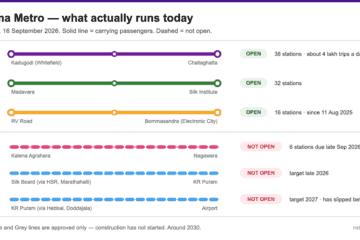
Let us be honest about the commute, because it has long been the area’s chief weakness. The arterial roads – Whitefield Main Road, Varthur Road and the ITPL approach – congest heavily during the 9:00-10:30 am and 6:00-8:00 pm peaks, a legacy of the area growing faster than its road network. The decisive change is the Bangalore Metro Purple Line, which now extends to Whitefield (Kadugodi) and finally gives the area a mass-transit spine into the city centre. For thousands of professionals, that flips the daily commute from painful to manageable, and property near the stations is expected to benefit.
Beyond the metro, the Outer Ring Road links Whitefield to Marathahalli, Sarjapur and the wider tech belt, while the upcoming Bangalore Suburban Rail promises additional commuter links. Kempegowda International Airport is reachable in roughly 50-70 minutes. The trajectory is clear: getting around Whitefield is set to get easier rather than harder over the next few years.
Schools, Healthcare & Daily Life
Few Bangalore districts match the area for social infrastructure. Reputed schools include Vydehi School of Excellence, Whitefield Global, Deens Academy, Gopalan International, Glentree Academy and VIBGYOR High, spanning CBSE, ICSE and IB curricula. Healthcare is anchored by Vydehi Institute, Manipal Hospital Whitefield and Columbia Asia, backed by a dense network of clinics and diagnostics. For daily life and leisure, Phoenix Marketcity, VR Bengaluru, Forum Shantiniketan and Park Square Mall deliver premium retail, dining, cinema and entertainment. This depth of existing infrastructure is a major reason established families keep choosing the area over cheaper but isolated alternatives further out.
Lifestyle & Community
The resident base is affluent, cosmopolitan and heavily skewed toward IT professionals, senior managers, and a large expatriate and returning-NRI segment. That gives the area an international, gated-community character, with cafes, microbreweries, sports complexes and green pockets that reflect the diversity of the tech workforce. Weekends revolve around the malls, dining and recreation that the area has accumulated over two decades. For a family deciding where to put down roots, the combination of professional neighbours, safety and a steady social rhythm makes the area an easy place to settle into, especially within a well-run gated development.
The Property Market in 2026
The Whitefield residential market spans the full range, from compact commodity apartments to premium low-density communities. Prices have appreciated steadily rather than spiked, kept disciplined by a continuous pipeline of new supply. For buyers, that is healthy – you are unlikely to overpay at the top of a bubble, and steady absorption signals genuine end-user demand. The clearest trend is buyers increasingly paying up for space, build quality and lower density as remote and hybrid work raised expectations of the home. Premium, brand-built stock holds value best and rents fastest, which is why quality-led developers continue to launch confidently across the district.
| Factor | Whitefield |
|---|---|
| Job Density | Very High |
| Rental Demand | Strong, year-round |
| Social Infra | Mature |
| Big Catalyst | Purple Line metro |
Micro-Markets Within the area
The district is not monolithic, and where exactly you buy shapes both commute and budget. The core around ITPL and Hope Farm commands a premium for the shortest office run and the most established retail, but accepts denser traffic. Toward Varthur, Gunjur and Sarjapur Road, prices ease and newer communities dominate, offering more space per rupee at the cost of a slightly longer drive. Pockets near Kadugodi benefit directly from the metro terminus. The trade-off is consistent across the district: the further from the office core you go, the more home and greenery you get, and the more you lean on the metro and ORR to keep your commute sane. Map your office address first, then pick the pocket that keeps your daily drive comfortable.
Pros and Cons of Buying in the area
The pros are compelling: unmatched job density, resilient rental demand, mature schools and healthcare, disciplined pricing and an operational metro. The cons are equally real. Peak-hour traffic on the arterials remains a frustration despite the metro, premium pockets carry a high entry price, and continuous new supply caps how fast prices can climb. If your workplace is in North Bangalore, Electronic City or the airport corridor, Whitefield is the wrong base. But for anyone anchored to the eastern tech belt, the trade-offs tilt firmly in favour of living here.
How to Choose the Right Project
Once you have settled on Whitefield, narrow down on three things: builder quality, distance from your office, and the open-space-to-density ratio of the project. A branded, lower-density community will out-live and out-rent a packed commodity tower over a long hold. Walk a sample unit on a weekday morning so you feel the real commute, verify the RERA completion date for your specific phase, and model the all-in cost including registration, GST and fit-out. Within the area, low-density projects from proven developers consistently deliver the best blend of livability and resale strength. For a worked example, read our full Sobha Windsor Phase 2 project guide, and compare it against medium-density options like Brigade Eternia.
A Budget Guide by Configuration
Buyers should set expectations by configuration. Compact 1 and 2 BHK homes remain the entry point and the easiest to rent, appealing to single professionals and young couples who prioritise a short commute over space. The 3 BHK is the volume seller and the natural choice for families, balancing room to grow against a manageable ticket size in premium projects. The 4 BHK and larger formats are end-user territory, bought by established families who want a forever home rather than a quick flip. Across all of these, branded stock carries a premium of perhaps 15-25% over commodity towers, and the premium consistently pays for itself in faster lets, stronger resale and fewer maintenance headaches. Build a 15-20% buffer over the base price into your plan to cover registration, taxes and interiors, and you will avoid the cash-flow squeeze that catches first-time buyers off guard.
A First-Time Buyer Checklist
Before you sign, run a short discipline checklist. Verify the project’s RERA registration and the specific completion date for your phase. Confirm the title is clear and the land is fully approved for residential use. Read the builder-buyer agreement carefully, paying attention to the carpet-versus-super-built loading, the penalty clauses for delay, and the maintenance and corpus obligations. Visit on a weekday morning to feel the real commute, and again on a weekend to gauge the community. Stress-test your loan so the EMI stays under 40% of household income even if a rental month is lost. Finally, compare at least two or three projects head to head on builder track record, distance to your office and open space before committing. Buyers who follow this checklist rarely regret their purchase; those who skip it often discover the gaps only after possession, when the leverage to fix them is gone.
Our Take
Weighing everything, Whitefield in 2026 remains one of the most sensible places in Bangalore to own a home if your professional life is rooted in the east. The job density underwrites your rent and resale, the social infrastructure makes daily life easy, and the operational metro has finally eased the one genuine pain point – the commute. Buy a quality, low-density project close to your office, hold it through the metro era, and Whitefield rewards you with both a comfortable home and a resilient asset. It is neither the cheapest nor the quietest part of the city, but for practical, demand-backed home ownership in East Bangalore, Whitefield is still hard to beat. The smartest buyers here are not chasing the lowest sticker price; they are buying proximity to a durable job market, a builder they can trust, and a community that will still feel right a decade from now.
A final word on timing, since it is the question every buyer wrestles with. The instinct to wait for a lower price often costs more than it saves: rents you pay while waiting are gone forever, interest rates and construction costs tend to drift upward, and the best units in a good project sell first. With the metro now operational and the employment base still expanding, much of the risk that historically justified waiting in this part of the city has already been retired. That does not mean rushing into the first show flat you see – it means doing your diligence efficiently, shortlisting two or three genuinely comparable projects, and being ready to act when you find the right home at a fair price. Buyers who treat the decision as a considered, time-bound process rather than an open-ended search almost always end up with a better outcome than those who wait indefinitely for a perfect moment that never quite arrives.