Retail Shops Investment in Bangalore: West Bengaluru Growth Guide 2026

For more than a decade, conversations around retail shops investment in Bangalore revolved around the city’s eastern and southern corridors – Whitefield, Sarjapur, Koramangala. But the real estate map is widening. West Bengaluru, long known for manufacturing and logistics, is now drawing serious attention from investors who want frontline retail at a fraction of central-city prices. If you are exploring retail shops investment in Bangalore for the first time, the Nagasandra-Tumkur Road belt deserves a careful look, because the fundamentals that drive shop-front demand – people, jobs, and movement – are all strengthening here at once.
This article walks through what actually makes retail shops investment in Bangalore work, why the western corridor is emerging, how the metro changes the math, and where a flagship development such as Arvind The Edge fits into the picture. We will keep it balanced – the upside is real, but so are the risks, and a good investor weighs both.
Why Retail Shops Investment in Bangalore Still Makes Sense
Bangalore remains one of India’s most resilient consumption markets. For retail shops investment in Bangalore, a young population, a salaried IT base, and a steady stream of migrants keep demand for groceries, food, services, pharmacies, and convenience retail high regardless of economic cycles. That structural demand is exactly why retail shops investment in Bangalore has historically delivered steadier occupancy than many other Indian cities. People may delay buying a flat, but they do not stop buying coffee, medicines, or a haircut.
Three forces drive ground-floor retail demand in this city: high-street footfall, proximity to metro stations, and the density of IT and industrial employment clusters nearby. When a location combines all three, the rental case for a shop strengthens considerably. The western corridor is now starting to tick all three boxes, which is why the narrative around retail shops investment in Bangalore is no longer purely an east-and-south story.
The West Bengaluru Shift: Nagasandra and Tumkur Road
Nagasandra, along Tumkur Road in West Bengaluru, is emerging as a genuine retail belt rather than just an industrial address. For years this stretch was defined by warehouses, factories, and through-traffic. Today the same characteristics that built its industrial weight – large land parcels, arterial road access, and a huge working population – are translating into demand for organised retail. That transformation is what makes retail shops investment in Bangalore along this corridor worth a closer study.
The appeal is straightforward. For retail shops investment in Bangalore, land and shop prices here remain lower than in saturated central locations, while the customer base is large and growing. A shop on Tumkur Road can serve factory workers, office staff, metro commuters, and surrounding residential pockets in a single catchment. For investors comparing options for retail shops investment in Bangalore, that diversity of footfall is a meaningful hedge – it means a single shop is not dependent on one type of customer.
How the Metro Extension Lifts Ground-Floor Retail
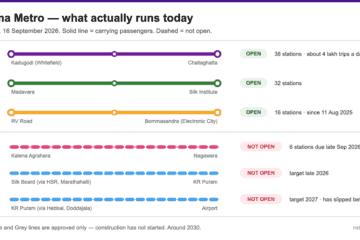
The single biggest catalyst for retail shops investment in Bangalore in this belt is the metro. Nagasandra sits on the Green Line, and in November 2024 the line was extended by 3.14 km to Madavara, adding three new stations – Manjunathanagar, Chikkabidarakallu, and Madavara. For retail shops investment in Bangalore, each new station pours a fresh stream of daily commuters onto the corridor, and metro footfall has a well-documented effect of lifting ground-floor retail in its immediate vicinity.
The logic is simple but powerful. Commuters walking to and from a station pass shops twice a day, every working day. That predictable, repeating footfall is gold for convenience retail, quick-service food, pharmacies, and service businesses. When evaluating retail shops investment in Bangalore, the distance between a shop and the nearest metro entrance is one of the most important numbers you can ask for – a few hundred metres can be the difference between heavy and modest walk-in traffic.
Peenya: The Industrial Engine Behind the Footfall
No discussion of retail shops investment in Bangalore in the west is complete without Peenya. Among the areas that form Asia’s largest industrial estate, Peenya has been notified as Bengaluru’s 18th Special Investment Region (SIR). That status signals continued policy focus, infrastructure spending, and employment growth – all of which feed directly into retail demand.
Why does an industrial estate matter so much for shops? Because it creates a large, captive, daytime population with money to spend on lunch, groceries, mobile recharges, banking, and everyday services. Unlike a purely residential catchment that empties during work hours, an industrial-cum-office belt keeps shops busy through the day. This daytime density is a quiet but decisive advantage for retail shops investment in Bangalore along the Tumkur Road corridor, and it pairs naturally with the evening footfall from metro commuters and nearby homes.
Arvind The Edge: A Flagship Example on Tumkur Road
A useful way to understand retail shops investment in Bangalore in this corridor is to study a concrete project. Arvind The Edge is a RERA-approved commercial development (RERA No. PRM/KA/RERA/1251/309/PR/190823/002822) by Arvind SmartSpaces, the listed real-estate arm of the Lalbhai Group. It sits on Tumkur Road in Nagasandra, roughly 200 m from the Nagasandra Metro station – well inside the walk-in radius that matters for shop-front trade.
The project is structured with ground-plus-two retail floors and office floors from the 3rd to the 13th level, which creates a built-in customer base of office workers above the shops. Retail units start from about 699 sq ft, with pricing from around Rs 1.60 Cr. For retail shops investment in Bangalore, design touches such as a glass facade and double-height shopfronts are aimed at visibility and brand presence – both of which support higher rents. For anyone benchmarking retail shops investment in Bangalore, a project that combines metro proximity, an office tower above, and an industrial catchment around it is a textbook example of the three demand drivers stacking together. You can read more about the wider micro-market in our overview of commercial property in Nagasandra.
Snapshot: Arvind The Edge at a Glance
| Attribute | Detail |
|---|---|
| Developer | Arvind SmartSpaces (Lalbhai Group, listed) |
| Location | Tumkur Road, Nagasandra, West Bengaluru |
| Metro distance | ~200 m from Nagasandra Metro (Green Line) |
| Configuration | Ground+2 retail floors; offices on floors 3-13 |
| Retail unit size | From ~699 sq ft |
| Indicative price | From ~Rs 1.60 Cr |
| RERA No. | PRM/KA/RERA/1251/309/PR/190823/002822 |
| Design features | Glass facade, double-height shopfronts |
Understanding Yields and Returns on Retail Shops Investment in Bangalore
Returns from a shop come from two sources: rental income and capital appreciation. Commercial retail in Bangalore typically generates higher rental yields than residential property, which is a core reason investors look at retail shops investment in Bangalore in the first place. A well-located shop can earn rent that comfortably outpaces what an apartment of similar value would fetch, and lease terms for commercial tenants are usually longer, which adds stability.
That said, yields are not guaranteed. They depend on the right tenant, the right rent, and continuous occupancy. A shop that stays vacant for months erodes its annual yield quickly. This is why location quality – footfall, visibility, and access – matters more than almost anything else in retail shops investment in Bangalore. The strongest returns tend to come from units that lease fast, retain tenants, and sit in catchments where demand is structural rather than speculative.
Outright Purchase vs Pre-Leased Shops
Investors broadly choose between buying a bare shop and leasing it themselves, or buying a shop that already has a tenant in place. A pre-leased option delivers rent from day one and removes the uncertainty of finding a tenant, though it usually carries a higher entry price. If predictable cash flow is your priority, exploring a pre-leased commercial property in Bangalore can be a sensible route. A bare unit, by contrast, gives you control over tenant selection and rent negotiation, and often a lower entry cost – at the price of leasing risk.
Comparing the Western Corridor With Other Bangalore Markets
It helps to see where the Nagasandra-Tumkur Road belt stands against more established retail markets. The table below is a simplified, directional comparison to frame the trade-offs in retail shops investment in Bangalore – it is not a price quote, and actual figures vary by exact location and unit.
| Corridor | Entry Price | Growth Stage | Key Driver |
|---|---|---|---|
| Nagasandra / Tumkur Road (West) | Lower | Emerging | Metro + Peenya industry |
| Whitefield (East) | Higher | Mature | IT parks |
| Koramangala (Central) | Highest | Saturated | Established high street |
| Sarjapur (South-East) | Mid-High | Growing | Residential + IT spillover |
The takeaway is that the western corridor offers a lower entry price at an earlier growth stage. That combination is precisely what attracts investors who want appreciation potential rather than fully-priced, mature-market yields. Of course, an earlier stage also means more uncertainty, which brings us to the risks.
The Honest Risks of Retail Shops Investment in Bangalore
Every investment guide that only lists positives is doing you a disservice. Retail shops investment in Bangalore carries real risks, and you should price them in before committing capital.
- Vacancy risk: A shop with no tenant earns nothing while you still pay maintenance, taxes, and possibly loan EMIs. Emerging corridors can take longer to lease than mature ones.
- Tenant quality: A weak tenant who defaults or vacates early can disrupt cash flow. Strong covenants matter more than a slightly higher headline rent.
- Oversupply: If many new commercial projects launch in the same belt simultaneously, rents can soften before demand catches up.
- Execution and timeline risk: For under-construction units, delivery delays push back your rent start date. A credible, listed developer reduces but does not eliminate this risk.
- Liquidity: Commercial shops can take time to sell. Treat retail shops investment in Bangalore as a medium-to-long-term hold, not a quick flip.
- Location specificity: Within the same project, two units can perform very differently. A corner unit with high visibility may thrive while an interior unit struggles.
None of these risks make retail shops investment in Bangalore a bad idea – they simply argue for due diligence. The investors who do well are the ones who treat shop-buying like a business decision, not a lottery ticket.
A Due-Diligence Checklist Before You Buy
Before you commit to any retail shops investment in Bangalore, work through a disciplined checklist. The items below apply whether you are looking at Arvind The Edge or any other project in the corridor.
- Verify RERA status independently on the Karnataka RERA portal – never rely on a brochure alone.
- Walk the catchment at different times to gauge real footfall, not theoretical footfall.
- Check the exact metro distance and the walking route, including crossings and obstructions.
- Study the unit position within the project – frontage, visibility, floor, and access.
- Assess the developer’s track record on delivery and quality.
- Model realistic yields using conservative rent and a realistic vacancy buffer.
- Read the agreement carefully – maintenance charges, common-area terms, and exit clauses all affect net returns.
Who Should Consider This Corridor?
Retail shops investment in Bangalore along the western corridor suits a particular kind of buyer. If you are looking for a fully matured, fully-priced asset with predictable, modest yields, an established central high street may suit you better. But if you want to enter an emerging belt early, accept some execution risk, and position for appreciation as the metro and industrial drivers mature, then Nagasandra and Tumkur Road are compelling. The presence of a listed developer like Arvind SmartSpaces in the area, through Arvind The Edge, also lends the corridor a degree of institutional credibility that newer micro-markets often lack.
In short, this is a corridor for the patient, research-driven investor. The fundamentals behind retail shops investment in Bangalore here – metro footfall, industrial employment, and a widening catchment – are aligning, but the rewards favour those who buy the right unit, at the right price, and hold with a clear plan.
Frequently Asked Questions
Is retail shops investment in Bangalore better than residential?
Why is the Nagasandra-Tumkur Road belt attracting investors?
How does the metro affect shop returns?
What is Arvind The Edge?
Should I buy a bare shop or a pre-leased one?
What are the main risks I should plan for?
How long should I plan to hold a retail shop?
How do I verify a project’s RERA status?
Disclaimer: This article is for general information only and is not investment, legal or tax advice. Verify all project details and RERA status independently before any decision.