Sattva City Investment: The Appreciation Case, the Yield Reality and Eight Risks

The Sattva City Investment Case In Two Sentences
The Sattva City investment case rests on infrastructure delivery on the airport corridor over a six-year holding period.
It does not rest on rental income, because Phase 1 hands over on 28 February 2032 and there is no rent before then.
Any Sattva City investment model that starts yield from the booking date rather than from handover will mislead you badly. That is the single most common error here.
This Sattva City investment guide separates the appreciation case, the income case and the exit case, because each needs different maths.
The Appreciation Half Of The Sattva City Investment
The Devanahalli belt has moved from roughly Rs 5,500 per sq ft in 2020 to Rs 11,000 to Rs 13,000 today.
That is roughly a doubling in six years, and it is the record any Sattva City investment thesis extrapolates from.
Four things drove that Sattva City investment backdrop. The airport expansion, the KIADB Aerospace SEZ, the Devanahalli business park and corporate relocation northward.
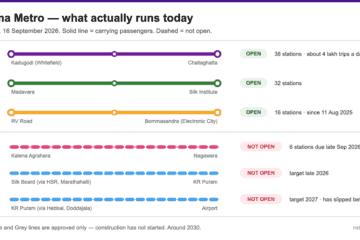
Two more land inside the holding period. The Namma Metro airport extension is under construction and the suburban rail plan places a station near Doddajala.
Track both on the Bangalore Metro Rail Corporation and K-RIDE sites rather than through a sales presentation.
Our forward view for the Sattva City investment is mid to high single-digit annual corridor growth, not the double digits sales channels sometimes imply.
Doubling once does not mean doubling again. The base is now three times higher, and percentage growth from a higher base is harder.
The Income Half Of The Sattva City Investment
Bangalore gross rental yields, the base for any Sattva City investment, typically run 2.5 to 3.5 percent, with premium stock at the lower end of that band.
Capital values in this corridor have risen faster than rents, which mechanically compresses yield. That trend is unlikely to reverse soon.
So a realistic Sattva City investment yield assumption is 2.5 to 3 percent gross from 2032, before maintenance and vacancy.
Net of maintenance at Rs 4 to Rs 6 per sq ft monthly, the effective yield drops meaningfully. Model it, do not assume it.
Tenant demand after handover should be genuinely solid. Airport staff, aerospace engineers, airline crew and hospitality management form a deep local pool.
Manyata and Hebbal technology employees add a second tenant stream, though the evening commute limits how many choose to live this far north.
Sattva City Investment Metrics Table
| Metric | This Project | Corridor Benchmark |
|---|---|---|
| Entry Rate | Rs 13,800 to 14,200 per sq ft | Rs 9,000 to 14,500 |
| Entry Ticket | Rs 1.82 Cr | Rs 90 L to Rs 3 Cr |
| All-In Uplift Over Basic | 9 to 11 percent | 8 to 12 percent |
| Expected Gross Yield | 2.5 to 3 percent from 2032 | 2.5 to 3.5 percent |
| Rental Income Start | March 2032 onward | Varies by project |
| Belt Appreciation Since 2020 | Roughly 2x | Roughly 2x |
| Maintenance Estimate | Rs 4 to 6 per sq ft monthly | Rs 3 to 6 |
| Supply Pressure | High | High |
| Resale Liquidity | Medium, improves post handover | Medium |
| Suggested Holding Period | Six years and beyond | Five years plus |
The Carrying Cost Nobody Models
This is where most Sattva City investment spreadsheets break. Six years of construction is six years of cost with no income.
If you are financing, you service pre-EMI or full EMI through construction depending on your disbursement schedule.
If you are paying cash, you carry the opportunity cost of the capital across the same six years.
If you are currently renting, you pay rent and instalments simultaneously. That combination is what breaks household budgets.
Add GST at five percent, stamp duty and registration at about six percent, and the one-time club, corpus and deposit items.
Our practical test for a Sattva City investment is simple. Model the full six years honestly, then ask whether the entry price still looks attractive.
Supply Risk On The Airport Corridor
The belt between Yelahanka and Devanahalli is the most heavily launched market in Bangalore right now.
Infrastructure spending attracts developers, developers add supply, and supply caps price growth for a period. This has happened on every Bangalore corridor.
Our Sattva City investment view is that the corridor absorbs it, because the employment base is genuinely expanding. Absorption takes years rather than quarters.
A Sattva City investment held to 2032 and beyond is unlikely to be hurt by the current supply wave.
A buyer planning to exit in 2028 at construction stage almost certainly will be. Construction-stage resale is the weakest exit in real estate.
Compare the competing supply directly at Godrej MSR City Shettigere and Prestige Park Street Devanahalli.
Exit Liquidity And Unit Selection
Scale cuts both ways for a Sattva City investment. A 3,460-home township builds its own resale market and its own resale competition.
When you sell, you are competing with hundreds of near-identical units, and possibly with the developer still selling later phases.
The practical consequence for a Sattva City investment is that unit selection matters more here than in a 300-unit project.
Buy something a future buyer can see from the brochure. Park-facing, corner or a genuinely differentiated floor.
Three of the five Phase 1 towers are park-facing and carry a Rs 100 per sq ft preferential charge. Corner units carry Rs 150.
Our view is that those premiums are worth paying purely on exit grounds. Commodity mid-stack inventory is the hardest thing to sell in a large township.
Sattva City Investment Risk Table
| Risk | Severity | How To Manage It |
|---|---|---|
| Timeline to February 2032 | High | Only buy with a six-year-plus horizon |
| Entry price at top of belt | Medium to high | Negotiate line items, not the headline rate |
| Corridor supply volume | High | Buy differentiated stock, avoid mid-stack |
| No income until handover | High | Model six years of carrying cost fully |
| Metro schedule slippage | Medium | Treat rail as upside, not base case |
| Amenity maintenance load | Medium | Get the projected figure in writing |
| Resale competition at scale | Medium | Prefer park-facing or corner units |
| Water and utility dependence | Medium | Confirm source, STP and harvesting design |
Who Should And Should Not Treat This As An Investment
A Sattva City investment suits the long-horizon buyer with a six-year-plus view and no need for interim income.
It suits the non-resident Indian buyer who wants registered, escrow-protected exposure to the strongest infrastructure corridor in Bangalore.
A Sattva City investment also suits the end-user who will occupy the home in 2032 and treats appreciation as a secondary benefit rather than the purpose.
It does not suit the yield investor. A 2.5 to 3 percent gross yield starting in 2032 does not compete with income assets available today.
It does not suit the short-horizon buyer. There is no clean exit before handover, and construction-stage resale destroys most of the gain.
On our internal scale we rate Sattva City investment risk at 6 out of 10, driven by timeline length and corridor supply rather than by any doubt about the site.
Sattva City Investment Frequently Asked Questions
Is Sattva City a good investment?
It is an appreciation and end-use asset rather than a yield asset.
The Devanahalli belt has roughly doubled since 2020 and both the metro airport extension and the suburban rail corridor land inside the holding period.
Against that, there is no rental income until Phase 1 hands over in February 2032, corridor supply is heavy, and the entry price sits at the top of the belt.
A six-year-plus horizon makes the case work. A three-year horizon does not.
What rental yield should a Sattva City investment assume?
Assume 2.5 to 3 percent gross from 2032, which is the realistic band for premium Bangalore stock.
Capital values in this corridor have risen faster than rents, and that compresses yield mechanically.
Net of maintenance at Rs 4 to Rs 6 per sq ft monthly plus vacancy allowance, the effective figure is lower still.
Tenant demand itself should be solid, drawing on airport staff, aerospace engineers, airline crew and hospitality management.
How much appreciation can a Sattva City investment expect?
Our forward view is mid to high single-digit annual corridor growth rather than the double digits sometimes quoted.
The belt moved from roughly Rs 5,500 per sq ft in 2020 to Rs 11,000 to Rs 13,000 today.
The base is now three times higher, and percentage growth from a higher base is harder to sustain.
The variable that matters most is metro delivery on the airport line, which would re-rate the whole corridor.
What is the biggest risk in a Sattva City investment?
Timeline. February 2032 is six years out, which is a long period for interest rates, employment patterns and buyer preferences to shift.
Second is entry price, since Rs 13,800 to Rs 14,200 per sq ft places this at the top of the belt and leaves less margin for error.
Third is corridor supply, because the Yelahanka to Devanahalli belt is the most heavily launched market in the city right now.
Can I exit a Sattva City investment before possession?
Legally yes, in most cases, subject to the developer transfer policy and any lock-in in the agreement. Practically it is the weakest exit available.
A construction-stage resale competes directly with the developer own inventory in later phases, and buyers discount heavily for the remaining wait.
Read the transfer clause before booking, including the transfer fee, and assume you will hold to handover rather than counting on an early exit.
Which unit is best for a Sattva City investment?
The 2 BHK at 1,316 sq ft carries the lowest ticket and the widest tenant pool, which suits a pure yield lens.
The 3 BHK at 1,820 sq ft has the deepest resale demand and is the volume seller. Whichever configuration you pick, prefer differentiated stock.
Three of the five Phase 1 towers are park-facing at Rs 100 per sq ft extra, and corner units carry Rs 150. Both premiums pay back at exit.
How does the six-year wait affect the returns?
Substantially, and it is the part most buyers leave out.
You carry EMI or opportunity cost for six years with no offsetting income, plus GST at five percent, stamp duty and registration at about six percent, and one-time club and corpus charges.
If you are also paying rent during that period, the combined outflow is heavy. Model all six years before deciding whether the entry price is genuinely attractive.
Is this better than a ready property for investment?
It depends entirely on your horizon. A ready property generates rent immediately, attracts no GST, and lets you inspect exactly what you are buying.
This project offers launch-stage pricing, first pick of inventory and exposure to six years of corridor infrastructure delivery. For an income-focused buyer the ready route usually wins.
For a capital-growth buyer with time and no need for income, the launch route can win comfortably.