Prestige KIADB 2 Investment: Why Anchored Aerospace Jobs Change the Math
The Thesis: Anchored Employment
The Prestige KIADB 2 investment case rests on something most emerging corridors cannot claim: physically anchored employment.
Aerospace, defence, precision engineering and electronics manufacturing cannot be performed remotely, and that is the foundation of the Prestige KIADB 2 investment argument. A precision manufacturing line cannot relocate to another city on a quarter’s notice the way a software team can.
That distinction matters more than most buyers appreciate. Corridors dependent on software employment discovered during the remote-work period that their tenant base could disperse in months. Manufacturing employment does not behave that way.
For a Prestige KIADB 2 investment, layer on the airport, the special economic zone and the second World Trade Center adding Grade A office, and you get a demand base with four independent sources rather than one.
The Four Demand Engines
The zone underpinning any Prestige KIADB 2 investment hosts aerospace, defence, precision engineering and electronics manufacturing across an area spanning roughly three thousand acres.
The special economic zone component adds export-oriented manufacturing and the supply chain that surrounds it, which generates its own layer of logistics and services employment.
The airport is a large direct and indirect employer across aviation, ground handling, cargo, hospitality, retail and security. It also drives hotel and business travel activity that supports service employment.
The second World Trade Center under development in the north adds Grade A office space, layering a white-collar employment type onto a belt previously dominated by aviation and manufacturing.
Four engines of different types is materially safer than one. A corridor running purely on a single sector inherits that sector’s cycle.
Corridor Investment Metrics Table
| Metric | Position | Comment |
|---|---|---|
| Corridor apartment range | Rs 7,500 – 11,500 per sq ft | All stock |
| Premium base rates | Rs 10,500 – 13,000 per sq ft | Current launches |
| Reported average | Approx Rs 11,000 per sq ft | Corridor data |
| Reported annual growth | Approx 18 percent | Treat as catch-up phase |
| Bengaluru gross yield | Approx 3 – 4 percent | Corridor at healthier end |
| Primary demand | Aerospace and defence manufacturing | Physically anchored |
| Secondary demand | Airport, cargo, hospitality | Established |
| Tertiary demand | Grade A office, second WTC | Emerging |
| Zone extent | Approx 3,000 acres | KIADB Aerospace Park |
| Developer precedent | Finsbury Park sold out, delivered | Same zone |
The Growth Number, And Our Caution
Reported price growth on the aerospace corridor has run near 18 percent a year, with commentary suggesting rates could reach Rs 14,000 per sq ft once metro operations begin.
Our position on a Prestige KIADB 2 investment is more cautious than the corridor consensus, and we would rather say so than repeat the headline.
Eighteen percent annual growth is not a sustainable base rate for any residential market. Compounded over a decade it produces numbers no local income base could support.
What that figure reflects is a specific catch-up phase, driven by airport capacity expansion, aerospace employment, metro construction and the Satellite Town Ring Road arriving in the same window. The corridor repriced from a low base to reflect all four at once.
The structural support is genuine and continuing. The rate of catch-up is not. Model steady growth and treat any repeat of recent gains as upside rather than as your base case.
The Yield Picture
For a Prestige KIADB 2 investment, Bengaluru gross rental yields typically run between 3 and 4 percent, stronger than Mumbai or Chennai. This corridor sits at the healthier end because the tenant base is genuine and locally anchored.
The tenant profile is distinctive: aerospace and precision manufacturing employees, airport and airline staff, cargo and logistics workers, hospitality management from the airport-corridor hotels, and increasingly office employees from the emerging Grade A stock.
The useful characteristic is again anchoring. These tenants need to be physically near their work, which supports occupancy more reliably than a tenant base that could work from anywhere.
The counterweight is supply. Multiple institutional developers hold land across this corridor and further launches inside the KIADB zone have been announced. Heavy simultaneous completion typically pauses rent growth even while capital values hold.
The Six Risks
Stage risk in a Prestige KIADB 2 investment is the largest and is more severe here than on a typical pre-launch. The developer has stated plans are yet to be announced. Even the product type is unsettled, so there is no realistic timeline to model and nothing to underwrite.
Supply risk is second. Expect meaningful competition when this parcel eventually comes to market.
Water risk is third and specific to North Bengaluru. Source, sanctioned capacity and dry-year contingency need written answers, because they affect both rentability and resale.
Industrial adjacency risk is fourth and particular to this address. Buffer distances, noise, industrial shift traffic and air quality are real considerations inside an aerospace and manufacturing zone, manageable with good masterplanning but requiring direct answers.
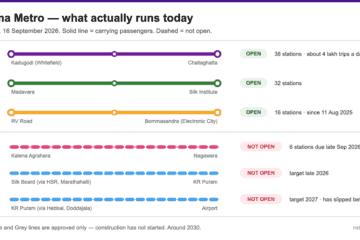
Metro timing risk is fifth, since part of the corridor’s current pricing already anticipates the Blue Line and published targets have moved between late 2026 and 2027.
Social infrastructure maturity is sixth. Bagalur is thinner on schools, healthcare and organised retail than the established northern pockets, which affects both family appeal and resale depth.
Risk Register Table
| Risk | Severity | Mitigation | |
|---|---|---|---|
| Stage, plans unannounced | Very high | Track only | nothing to underwrite yet |
| Corridor supply volume | High | Expect rent pressure, negotiate hard | |
| Water source and security | Medium-high | Confirm source and contingency in writing | |
| Industrial adjacency | Medium | Ask about buffers, noise, shift traffic | |
| Metro schedule | Medium | Underwrite on today’s connectivity | |
| Social infrastructure | Medium | Thinner than established north | |
| Growth expectations | Medium | Model steady, not 18 percent compounding | |
| Employment maturity | Low-medium | Real but smaller than ORR or Whitefield |
How To Position On This Corridor
Our recommendation on a Prestige KIADB 2 investment is modest and specific, because the stage demands it.
Track this parcel. Register interest through the developer’s official channel. But recognise that with no announced product, price or timeline, there is currently nothing to underwrite.
If you want exposure to this corridor within the next two years, buy something that exists. Prestige Grove Hills at Bagalur gives you the same developer in the same belt. Purva Northern Lights from Rs 1.19 crore gives you a live price and evaluable product.
Consider format carefully. Plots such as Brigade KIADB Plots from Rs 95 lakh have delivered the strongest appreciation on this belt historically but generate no income and require you to build. Apartments generate rent from handover with a deeper resale market. Match the format to whether you need income, appreciation or occupancy.
Size the position for a long horizon. This corridor rewards patience and punishes anyone who needs liquidity quickly.