Mahindra Sadahalli Investment: Why 118 Percent Appreciation Is a Warning Too
The Numbers, And Then The Caveat
The Mahindra Sadahalli investment case sits inside one of the best-documented appreciation stories in Indian real estate.
Devanahalli residential rates moved from around Rs 5,500 per sq ft in 2020 to Rs 11,000 to Rs 13,000 in 2026. Land in the Devanahalli and Shettigere belt went from about Rs 4,500 per sq ft in 2024 to between Rs 7,000 and Rs 9,600 by March 2026, a rise of 60 to 110 percent in two years. Plotted developments have delivered around 118 percent over four years.
Now the caveat, which matters more to a Mahindra Sadahalli investment than the numbers themselves. That was catch-up growth from a very low base, driven by airport expansion, the aerospace cluster, metro construction and the Satellite Town Ring Road arriving in the same window.
Assuming it simply continues is the classic error on this corridor. The structural support is genuine and continuing. The easiest money has already been made.
What Still Supports The Corridor
Four forces underpin any Mahindra Sadahalli investment, and three are still running. They have driven North Bengaluru and three of them are still running.
Airport capacity expansion is the most durable, because it generates direct employment, hospitality demand, logistics activity and business travel simultaneously, and it is not easily reversed.
The KIADB Aerospace Park and Special Economic Zone at Bagalur continues to attract aerospace and precision manufacturing investment, which is a different and more physically anchored employment type than software.
The Satellite Town Ring Road improves regional connectivity and lateral movement across the north, expanding the practical catchment of the whole belt.
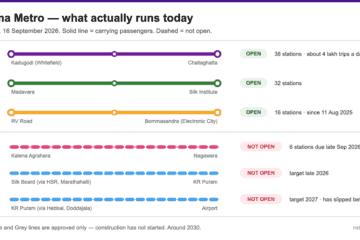
Metro construction on the Blue Line is the fourth, and it is the one whose timing has slipped. Part of current corridor pricing already anticipates its arrival, which is precisely why it should be treated as upside rather than as an assumption.
Appreciation Track Record Table
| Metric | Value | Period |
|---|---|---|
| Devanahalli rate 2020 | Approx Rs 5,500 per sq ft | Base |
| Devanahalli rate 2026 | Rs 11,000 – 13,000 per sq ft | Current |
| Sadahalli near NH 44 | Rs 12,500 – 13,000 per sq ft | Current |
| Micro-market ceiling | Approx Rs 14,500 per sq ft | Lodha Sadahalli |
| Devanahalli land 2024 | Approx Rs 4,500 per sq ft | Base |
| Devanahalli land Mar 2026 | Rs 7,000 – 9,600 per sq ft | 60 – 110 percent rise |
| Plot appreciation | Approx 118 percent | Four years |
| Bengaluru gross yield | Approx 3 – 4 percent | Current |
The Yield Picture
For a Mahindra Sadahalli investment, Bengaluru gross rental yields typically run between 3 and 4 percent, which is stronger than Mumbai or Chennai. North Bengaluru sits at the healthier end because tenant demand from airport and aerospace employment is genuine rather than speculative.
The tenant profile behind a Mahindra Sadahalli investment is distinctive and worth understanding. Airport and airline staff. Aerospace and precision manufacturing employees. Hospitality management from the airport-corridor hotels. Consultants and executives who fly frequently and value the proximity enough to pay for it.
That profile has a useful characteristic: it is physically tied to the location. An aerospace plant employee cannot work remotely from another city. That anchors demand more firmly than a software tenant base would.
The counterweight is supply. Substantial inventory is completing across the belt over the next several years, which pressures rents even while capital values hold. Do not assume a landlord’s market.
Net zero specification should help on the rental side, because lower utility bills are a benefit a tenant feels monthly. Whether that converts into a measurable rent premium is not yet established in this market, so do not underwrite it.
The Five Risks
Timeline risk in a Mahindra Sadahalli investment is first. This is pre-launch on a consolidated land assembly, with approvals and Karnataka RERA registration still ahead, followed by what appears to be phased construction. Model a long horizon before any income or exit.
Supply risk is second and is the most underrated on this corridor. Almost every major developer holds land in the Devanahalli belt.
Water risk is third and is specific to North Bengaluru. Source and dry-year contingency are hard diligence items because they affect both rentability and resale.
Metro timing risk is fourth, since some of the corridor’s current pricing already anticipates the Blue Line and published targets have moved.
Pricing risk is fifth. If a launch rate approaches the roughly Rs 14,500 per sq ft ceiling set by Lodha Sadahalli, much of the near-term appreciation is already inside your entry price.
Risk Register Table
| Risk | Severity | Mitigation | |
|---|---|---|---|
| Timeline | High | Model long hold | wait for RERA date |
| Corridor supply volume | High | Expect rent pressure, negotiate hard | |
| Water source and security | Medium-high | Confirm source and contingency in writing | |
| Metro schedule | Medium | Underwrite on today’s connectivity | |
| Entry pricing | Medium | Benchmark against Rs 12,500 – 14,500 band | |
| Employment maturity | Medium | Base still smaller than ORR or Whitefield | |
| Yield compression | Medium | Do not underwrite a rent premium | |
| Exit liquidity | Low-medium | Deep buyer interest in corridor |
How To Size This Position
Our position on a Mahindra Sadahalli investment is that the corridor retains structural support but the return profile has changed. Model steady growth rather than a repeat of 2024 to 2026.
Do not commit capital before Karnataka RERA registration exists. Under the Real Estate (Regulation and Development) Act a promoter cannot advertise, book or sell units in a project requiring registration until it is granted, and no investor should transact outside that framework however attractive the early terms sound.
When pricing appears, run the checks: against the Rs 12,500 to Rs 13,000 Sadahalli micro-market band, against the roughly Rs 14,500 ceiling, and on carpet area rather than super built-up. A launch in the lower half of that range is a reasonable entry. At or above the ceiling, you are paying for appreciation that has already happened.
Compare across formats before committing to a Mahindra Sadahalli investment. Apartments, villas at Prestige Shettigere and plots at Brigade KIADB from Rs 95 lakh have genuinely different appreciation and liquidity profiles on this corridor.