Pink Line Metro Real Estate: How the New Line Drives Value

For more than a decade, the property conversation in south Bangalore has circled the same arteries – Bannerghatta Road traffic, the long crawl to Electronic City, and the wish that a metro would finally arrive. That wish is now turning into steel and concrete. The Namma Metro Pink Line is the single most important infrastructure event for this part of the city in a generation, and it is reshaping how buyers and investors think. Pink Line metro real estate has moved from a speculative phrase in broker pitches to a measurable trend backed by transaction data, rising rents, and a fresh wave of Grade-A supply. For Pink Line metro real estate, the simple truth is that a working underground metro changes the value equation for every street within walking distance of a station. Search demand for Pink Line metro real estate has climbed sharply as the line nears commissioning, and that interest is now being matched by genuine on-ground activity.
This article is a practical, honest walkthrough of what the Pink Line metro real estate market actually offers in 2026. We will explain what the Pink Line is, trace the corridor from Gottigere to Nagawara, look at the specific micro-markets it unlocks, examine how metro proximity drives prices and rents, and lay out an honest risks section. We will also use projects such as Arvind Skycrest, Bannerghatta Road to show how new developments are positioned to capture this upside. Whether you are an end-user buying your first home, a landlord chasing rental yield, or a long-term wealth builder, the goal is to give you the full picture – the good and the not-so-good.
What Exactly Is the Namma Metro Pink Line?
The Pink Line is Reach 6 of Namma Metro’s Phase 2 expansion. It runs roughly 21 km from Kalena Agrahara, on the southern edge of the city near Gottigere on Bannerghatta Road, all the way to Nagawara in the north-east, near the Outer Ring Road. What makes this line special – and what makes Pink Line metro real estate so distinctive – is its engineering. A large portion of the corridor is underground, including what is described as India’s longest continuous underground metro stretch, tunnelled beneath some of the most congested and built-up parts of central Bangalore.
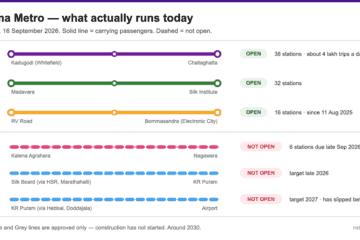
Because the line burrows under the city core rather than running on elevated viaducts, it threads directly through neighbourhoods that have never had rapid transit before. That underground reach is exactly why Pink Line metro real estate is generating so much attention in 2026. The Pink Line carries around 18 stations, a mix of underground and elevated, and it is opening in phases through 2026 as tunnelling, station fit-out, and testing are completed in sequence. For anyone evaluating Pink Line metro real estate, the phased opening is the single most important operational fact: different stretches go live at different times, so the value of a given location depends partly on when its nearest station actually starts carrying passengers. In short, the Pink Line metro real estate map is best read station by station rather than as one block.
The Corridor: Stations and Micro-Markets the Pink Line Unlocks
The genius of the Pink Line is its routing. It connects the deep south of Bangalore to the central business district and then onward to the north-east, stitching together areas that were previously linked only by clogged surface roads. For Pink Line metro real estate, the most consequential stretch is the southern segment along Bannerghatta Road, because that is where land is still relatively affordable and where the appreciation runway is longest. Anyone mapping Pink Line metro real estate opportunities should start here and work northward.
Starting from the southern terminus, the corridor passes through a string of recognisable nodes. Each of these stations creates its own catchment, and each is now a distinct chapter in the Pink Line metro real estate story.
- Kalena Agrahara / Gottigere: The southern terminus and the epicentre of the early Pink Line metro real estate price movement, with the strongest observed appreciation so far.
- Hulimavu: A fast-growing residential pocket on Bannerghatta Road that benefits directly from station access and improving social infrastructure.
- IIMB and Bannerghatta Road stations: Serving the education, hospital, and office belt along this arterial road – a natural demand magnet.
- JP Nagar: An established, premium residential area where the metro adds a connectivity layer that further strengthens an already mature market.
- Dairy Circle: A pivotal interchange-style node linking the southern stretch into the central core and toward the city centre.
- Central Bangalore: Underground stations beneath the dense city core, connecting the corridor to the central business district and onward to Nagawara.
This routing is why Pink Line metro real estate is not a single market but a chain of micro-markets, each with its own price point, buyer profile, and risk level. The southern end offers value and growth; the central stretch offers connectivity and convenience at a premium that is already largely priced in.
How Metro Proximity Drives Prices and Rents
There is a well-documented relationship between operational metro stations and property values, and it applies cleanly to Pink Line metro real estate. Around the Gottigere and Kalena Agrahara end of the corridor, market observers have already noted appreciation in the region of 15-20 percent as the line progressed from announcement to active construction and partial commissioning. That is the classic metro-premium pattern: prices begin moving on the announcement, climb through construction, and consolidate once trains are actually running.
The mechanism behind Pink Line metro real estate appreciation is straightforward. A metro station delivers a predictable, daily stream of commuters, which compresses commute times and removes dependence on cars and two-wheelers stuck in Bannerghatta Road traffic. That convenience is something buyers and tenants will pay for, and it is precisely what underpins Pink Line metro real estate rents. Homes within a genuine walking distance of a station rent faster and command higher rents, and resale demand is deeper because the pool of interested buyers is larger. This is the core reason Pink Line metro real estate near working stations tends to outperform comparable property a few kilometres away with no transit access.
Pink Line Metro Real Estate: Corridor Snapshot
The table below summarises the parameters that define the Pink Line corridor. Treat the figures as indicative ranges for understanding the market, not as a fixed price list – actual numbers vary by station, project, floor, and timing, and should always be confirmed directly with the developer and verified independently.
| Parameter | Detail | Why It Matters |
|---|---|---|
| Line | Namma Metro Pink Line (Reach 6) | New transit spine anchoring Pink Line metro real estate |
| Route | Kalena Agrahara (Gottigere) to Nagawara | Links deep south to the central business district |
| Length | About 21 km, India’s longest underground stretch | Burrows under dense, never-before-served core |
| Opening | Phased through 2026 | Value depends on when your station goes live |
| Hot micro-market | Gottigere / Kalena Agrahara | Roughly 15-20 percent appreciation observed |
| Key arterial | Bannerghatta Road | Education, hospital, and office demand belt |
| Best entry point | Southern stretch near Gottigere | Longest remaining appreciation runway |
Which Micro-Markets Benefit Most?
Not every station along the corridor offers the same opportunity, and treating Pink Line metro real estate as one undifferentiated block is a mistake. The smart approach is to match the micro-market to your objective. Below is how the Pink Line metro real estate corridor breaks down for different goals.
1. Gottigere and Kalena Agrahara – the value-growth play
The southern terminus is where the largest gains have already shown up, and where the remaining runway is longest. Land here was historically cheaper, so even after the 15-20 percent move, entry prices remain accessible relative to central Bangalore. For appreciation-focused buyers, this is the heart of the Pink Line metro real estate opportunity. Gottigere real estate in particular has become a focal point for new launches positioned around the terminus station.
2. Bannerghatta Road and Hulimavu – the end-user sweet spot
For families who actually want to live near a station, the Bannerghatta Road belt combines schools, hospitals, malls, and offices with imminent metro access. This is where Pink Line metro real estate delivers everyday liveability, not just an investment thesis. End-users tend to find the best balance of price and amenity here, which is why owner-occupier demand for Pink Line metro real estate is strongest in this pocket.
3. JP Nagar and Dairy Circle – the premium-stability play
These mature, well-regarded areas already command higher prices, so the metro adds a stability-and-liquidity layer rather than dramatic upside. For conservative buyers who value an established neighbourhood, this stretch of Pink Line metro real estate offers lower risk in exchange for more modest growth.
4. Central Bangalore – the connectivity premium
The underground central stations offer unmatched access to the business district, but property here is already expensive and the metro premium is largely baked in. This part of the Pink Line metro real estate market suits those who prize location above price growth.
A Flagship Example: Arvind Skycrest Near Gottigere
To make the thesis concrete, consider a development positioned to capture exactly these dynamics. Arvind Skycrest, Bannerghatta Road is located close to the Gottigere Pink Line station, at the southern end of the corridor where the appreciation runway is longest. It is developed by Arvind SmartSpaces, the listed real-estate arm of the Lalbhai Group – a developer pedigree that matters in a market where execution risk and title clarity can make or break an investment. Buyers should independently verify its RERA registration on the Karnataka RERA portal before committing.
Projects like Arvind Skycrest illustrate the Pink Line metro real estate playbook neatly: pick a credible developer, target a location near a station on the high-growth southern stretch, and buy ahead of full commissioning to capture the next leg of appreciation. This is the template most thoughtful Pink Line metro real estate buyers are following in 2026. We highlight it as one example, not the only choice – the disciplined buyer always compares multiple projects, verifies every claim, and treats proximity to the station as something to confirm on foot rather than assume from a brochure.
Buying Near a Pink Line Station: A Practical Checklist
Before you sign anything in the Pink Line metro real estate market, run through this disciplined checklist. It will protect you from the most common and costly mistakes that catch first-time Pink Line metro real estate buyers along the corridor.
- Confirm the official opening schedule for your specific station – phased commissioning means timelines differ across the corridor.
- Walk the actual distance from the station entrance to the property door and time it; a true metro-adjacent home should be a comfortable few minutes’ walk.
- Verify the project’s RERA registration number on the official Karnataka RERA portal – never take it on trust.
- Check how much of the metro premium is already priced in versus how much appreciation may still lie ahead.
- Study the local rental market and realistic yields if you intend to let the property out.
- Review the developer’s delivery track record, the agreement’s possession timeline, maintenance charges, and penalty clauses.
- Engage an independent lawyer for title verification before any payment for Pink Line metro real estate.
Pink Line Metro Real Estate: Pros and Cons at a Glance
A clear-eyed buyer weighs strengths against risks. The table below summarises both sides of the Pink Line metro real estate decision so you can judge whether this corridor fits your goals. Read it before you commit to any Pink Line metro real estate purchase.
| Strengths | Risks to Weigh |
|---|---|
| Direct transit lifts Pink Line metro real estate values toward the central business district | Phased opening means uncertain station-level timelines |
| Pink Line metro real estate near Gottigere up 15-20 percent | Some premium already priced into hot pockets |
| Relief from Bannerghatta Road traffic dependence | Construction disruption and dust until commissioning |
| Deeper resale and rental demand near stations | Overpaying for loosely-defined metro proximity |
| Affordable entry on the southern stretch | Project execution and possession delay risk |
The Honest Risks You Must Weigh
No corridor is perfect, and anyone selling you Pink Line metro real estate without mentioning the downsides is not being straight with you. The headline risk is timing. Because the line opens in phases through 2026, the metro premium you pay today is partly a bet on a future commissioning date. If your station’s opening slips, the convenience you paid for arrives later than expected, and your capital sits idle in the meantime. Always anchor your decision to the official schedule, not to optimistic marketing.
The second risk is that part of the appreciation is already behind you. The 15-20 percent move near Gottigere means some of the easy gains have been captured; buyers entering now should expect more measured Pink Line metro real estate growth rather than a repeat of the early surge. There is also construction disruption to live with – tunnelling, station works, and traffic diversions create noise, dust, and access headaches until the line is commissioned. Finally, the usual property risks apply in full: execution and possession delays on under-construction projects, the danger of overpaying for a home that is only loosely “near the metro,” and the need for rigorous title and RERA verification. Pink Line metro real estate rewards discipline and punishes blind optimism, just like any other market.
The Outlook for Pink Line Metro Real Estate
Looking ahead, the structural case for Pink Line metro real estate is strong. Once fully commissioned, the Pink Line will give south and central Bangalore a transit backbone that simply did not exist before, converting car-dependent neighbourhoods into walkable, metro-connected ones. That is a durable, one-way upgrade to the area’s connectivity profile, and it will keep supporting Pink Line metro real estate demand long after the headlines fade. The southern stretch around Gottigere, where affordability meets the longest growth runway, looks particularly well-positioned for buyers entering in 2026.
That said, this will be a phased, multi-year maturation, not an overnight transformation. The smart way to approach Pink Line metro real estate is with realistic timelines, thorough due diligence, and a clear sense of which micro-market and buyer profile you fit. Buy the right home, near the right station, at the right price, and the fundamentals of this corridor give you a genuinely strong foundation. Buy carelessly, chasing a premium that is already priced in or a station that is years from opening, and the same market can disappoint. The Pink Line does the heavy lifting; the discipline is yours to bring. For investors comparing south Bangalore options, it is also worth weighing this corridor against alternatives such as property investment near Electronic City, which serves a different demand driver entirely.
Frequently Asked Questions on Pink Line Metro Real Estate
What is the Namma Metro Pink Line?
Why is Pink Line metro real estate considered a good opportunity?
Which areas does the Pink Line unlock?
How much have prices risen near Gottigere?
When does the Pink Line open?
What is an example of a project on this corridor?
What are the main risks of buying here?
Related Reading
Disclaimer: This article is for general information only and is not investment, legal or tax advice. Verify all project details, metro timelines and RERA status independently before any decision.