Devanahalli Real Estate Investment: The 2026 North Bangalore Growth Guide

For anyone weighing a devanahalli real estate investment in 2026, the story is no longer about a far-flung village near the airport. Devanahalli has matured into North Bangalore’s strongest STRR-led growth corridor, sitting roughly 20 minutes from Kempegowda International Airport and surrounded by some of the largest industrial and aerospace commitments the state has ever seen. Buying land here today is, in practical terms, a bet on infrastructure that is already under construction rather than speculation about a distant future, and that distinction matters enormously for capital safety.
This guide breaks down why the numbers stack up, the demand drivers behind the rise, real price-appreciation data from 2022 to 2025, the plots-versus-apartments debate, the rental yield outlook, realistic ROI scenarios, and the honest risks you should weigh before committing capital. Wherever it helps, we point to Arvind Orchards Devanahalli as a representative orchard-themed villa-plot project that shows how a quality devanahalli real estate investment is structured on the ground.
Why the Numbers Stack Up in 2026
The case for a devanahalli real estate investment rests on a simple idea: location value follows infrastructure, and few Bangalore micro-markets have as much confirmed infrastructure flowing into them. The region is anchored by Kempegowda International Airport, so buying here effectively gives you proximity to an asset that handles tens of millions of passengers a year and keeps expanding its terminals and cargo capacity.
Unlike South and East Bangalore, where land is largely consumed and prices have already run up sharply, the North still has developable land at comparatively reasonable entry points. That gap is exactly what makes a devanahalli real estate investment attractive to first-time land buyers and seasoned investors alike. You are entering a corridor early in its compounding cycle rather than at the tail end of one, and early entry is historically where the largest gains are captured. For buyers specifically hunting plots near Bangalore airport, Devanahalli is the natural focal point because no other airport-adjacent node combines this much industrial demand with this much land supply.
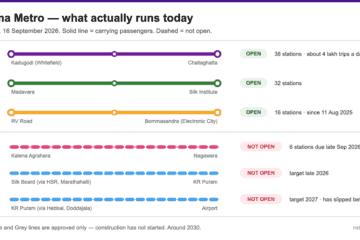
Policy tailwinds reinforce the thesis. The Satellite Town Ring Road (STRR) is reshaping connectivity across the belt, and the proposed airport metro Blue Line, linking KR Puram to KIA, will eventually pull the town into Bangalore’s rapid-transit map. Each of these reduces the friction of living and working here, and reduced friction is what converts a speculative bet into a self-sustaining residential and commercial hub.
The Demand Drivers Behind the Boom
No devanahalli real estate investment thesis holds up without genuine employment and demand drivers. This corridor has them in unusual concentration:
KIADB Aerospace Park (847 acres): Home to giants like HAL, DRDO and Boeing, the Aerospace Park is the gravitational centre of the corridor. High-skill, high-income jobs cluster here, and that is precisely the workforce that fuels demand for both plots and rental housing. You can read more about this anchor in our dedicated piece on the KIADB Aerospace Park and its property impact.
Foxconn iPhone plant: Commissioned around August 2025 with an outlay of roughly $2.8 billion, the Foxconn facility is one of the largest manufacturing commitments in the region. Thousands of direct and indirect jobs translate into sustained housing demand, strengthening the floor under any land purchase in the belt.
SAP and IT investment: SAP’s commitment of around Rs 1,960 crore adds a technology layer to the industrial base, diversifying the kind of buyer and tenant a devanahalli real estate investment can attract.
STRR and the airport metro Blue Line: Connectivity converts potential into realised value. The STRR knits the town into a wider regional grid, while the Blue Line metro promises mass-transit access. For a long-horizon devanahalli real estate investment, these are the catalysts that historically precede the steepest appreciation curves.
Price Appreciation History & Data

Data, not hype, should drive any devanahalli real estate investment decision. Between 2022 and 2025, land in the Devanahalli belt appreciated by roughly 35-40% overall. That is the headline number, but the more interesting story sits in the high-growth pockets. Localities like Bagalur and Doddajala have seen appreciation of around 15-20% per year, far outpacing the broader market, because they sit closest to the new employment nodes.
The table below summarises how the corridor has behaved over this window. Treat these as honest ranges, not guarantees; actual outcomes vary by exact location, title quality and timing.
| Period / Pocket | Appreciation | What Drove It |
|---|---|---|
| Devanahalli belt (2022-2025) | ~35-40% cumulative | Airport, STRR, broad infra |
| Bagalur (high-growth pocket) | ~15-20% per year | Aerospace Park proximity |
| Doddajala (high-growth pocket) | ~15-20% per year | Airport & job-node proximity |
| Rental yield near Aerospace Park | ~3.8-4.8% | High-income tenant demand |
| Rental yield, central Bangalore | ~3% | Saturated, high base prices |
What this data tells a prospective buyer is that the corridor has already delivered tangible returns to early movers, and the gap versus saturated city markets remains wide. Crucially, the appreciation has been infrastructure-led rather than purely speculative, which is the healthier kind of growth to underwrite for a long-term devanahalli real estate investment.
Plots vs Apartments for a Devanahalli Real Estate Investment
One of the first decisions is asset type. In this corridor, villa plots and managed plotted developments have a structural edge over apartments for investors with a 5-7 year horizon. Land appreciates; buildings depreciate. In an early-stage growth market, the underlying land component is exactly what you want maximum exposure to, which is why so much of the smart money in a devanahalli real estate investment flows into plots.
Plotted projects also carry lower carrying costs, no maintenance-heavy structure to age, and far greater flexibility, whether you eventually build a villa, hold for capital gains, or sell to an end-user. Orchard-themed villa-plot projects such as Arvind Orchards Devanahalli by Arvind SmartSpaces are designed around this exact logic, pairing the land-appreciation upside of a devanahalli real estate investment with a green, low-density lifestyle that end-buyers increasingly want.
| Factor | Villa Plots | Apartments |
|---|---|---|
| Primary value driver | Land (appreciates) | Structure (depreciates) |
| Carrying / maintenance cost | Low | Higher, ongoing |
| Flexibility | High (hold, build, sell) | Low |
| Liquidity | Lower, longer to sell | Generally faster |
| Best horizon | 5-7 years | 3-5 years |
| Fit for this corridor | Strong | Moderate |
That said, plots are less liquid than apartments. If you may need to exit quickly, factor that into your devanahalli real estate investment plan. The trade-off is that the patient plot investor is usually rewarded with stronger capital appreciation in a market like this one.
Rental Yield Outlook
Rental income matters even for a land-focused strategy, because it signals the depth of end-user demand. Near the Aerospace Park, gross rental yields run around 3.8-4.8%, noticeably above central Bangalore’s roughly 3%. The reason is straightforward: high-income engineers and managers from HAL, Boeing, Foxconn and SAP need quality housing close to work, and supply has not yet caught up.
For a plotted devanahalli real estate investment, the practical play is to build a villa once the neighbourhood matures and capture both rental yield and capital appreciation. In the interim, the rising rental benchmark provides a useful reality check that demand is real, not theoretical. A devanahalli real estate investment supported by 3.8-4.8% yields has a far stronger fundamental floor than one resting on price momentum alone.
ROI Scenarios & Investment Horizon
Let us be honest about timeframes. A devanahalli real estate investment, especially in land, is not a quick flip. The meaningful gains historically accrue over a 5-7 year horizon as infrastructure completes and the corridor densifies. Within that window, here is how to think about scenarios, using the appreciation ranges observed from 2022 to 2025 as a guide rather than a promise.
Conservative scenario: If appreciation moderates to the lower end of historic ranges, a devanahalli real estate investment held 5-7 years could still meaningfully outpace city-core property and most fixed-income alternatives, driven by the airport and STRR base effect.
Base scenario: Continued infrastructure delivery (Foxconn ramp-up, metro progress) keeps a devanahalli real estate investment compounding at rates closer to the corridor average, with high-growth pockets like Bagalur and Doddajala potentially exceeding it.
Optimistic scenario: If job creation accelerates and the metro Blue Line lands on schedule, an early devanahalli real estate investment in a prime pocket could see outsized gains, though no responsible adviser will guarantee this.
The discipline that protects your capital is matching the asset to your time horizon. If you cannot stay invested for at least five years, land here may not be the right fit, and a more liquid instrument might suit you better.
How to Pick the Right Project
The quality of a devanahalli real estate investment depends heavily on the specific project, developer and title. A few non-negotiables: verified RERA registration, clean and marketable title, a credible developer track record, and a location close to confirmed employment and connectivity nodes. Skipping any of these turns a sound devanahalli real estate investment into a gamble.
This is where a project like Arvind Orchards Devanahalli stands out as a reference point. Developed by Arvind SmartSpaces, it offers orchard-themed villa plots in sizes of 1200, 1500 and 2400 sq ft, with pricing roughly from Rs 72 lakh to Rs 1.9 crore, and it carries RERA registration PRM/KA/RERA/1250/303/PR/300124/006600. That combination of a reputable developer, transparent RERA status and prime location is exactly the profile a disciplined devanahalli real estate investment should target.
Whatever project you choose, cross-check the RERA number on the official portal, study the master plan, walk the site, and confirm road and utility access. A devanahalli real estate investment made on verified facts ages well; one made on a brochure rarely does. It is also worth visiting at different times of day to gauge traffic, water access and the pace of surrounding construction, since these everyday realities shape both your living experience and your eventual resale story.
How Devanahalli Compares to Other Bangalore Corridors
Context sharpens any devanahalli real estate investment decision, so it helps to benchmark the corridor against the alternatives. Sarjapur and Whitefield in the east are mature, liquid and well-serviced, but entry prices are high and much of the easy appreciation has already happened. The Tumkur Road and Mysuru Road belts offer affordability but lack the singular, jobs-plus-airport catalyst that defines the north. Against that backdrop, a devanahalli real estate investment occupies a rare sweet spot: still-reasonable land prices paired with confirmed, large-scale infrastructure.
The other distinction is the quality of demand. A devanahalli real estate investment is underwritten by aerospace, manufacturing and technology employers paying high salaries, rather than by a single IT park. That diversity of demand makes the corridor more resilient to any one sector’s slowdown, which is a genuine, often-overlooked advantage when you compare a devanahalli real estate investment with a single-industry micro-market elsewhere in the city.
Step-by-Step: Making Your First Purchase
If you are new to the corridor, approach your first devanahalli real estate investment as a sequence rather than a single leap. First, fix your budget and horizon honestly; this is a 5-7 year asset, not a trading position. Second, shortlist RERA-registered projects from credible developers and compare them on title, location and amenities, not just price per square foot.
Third, conduct legal due diligence: verify the RERA number, the title chain, the encumbrance certificate and the khata or conversion status. Fourth, visit the site, confirm road and utility access, and gauge the pace of nearby construction. Only then commit capital. Following this discipline turns a speculative devanahalli real estate investment into a calculated one, and it is exactly the process a careful buyer applies before booking a plot at a project like Arvind Orchards. Done well, a first devanahalli real estate investment also teaches you the corridor well enough to act faster and with more conviction on the next one.
Risks & Honest Cons
No guide is complete without the downside. A devanahalli real estate investment carries real risks that you should price in before buying:
Illiquidity: Land is the least liquid major asset class. Exiting a devanahalli real estate investment can take months, sometimes longer, and forced sales often mean accepting a discount. Only commit capital you will not need at short notice.
Long gestation: The strongest returns on a devanahalli real estate investment typically materialise over 5-7 years. Infrastructure timelines, especially the metro, can slip. Patience is a prerequisite, not an option.
Title and approval risk: The single biggest avoidable mistake in any devanahalli real estate investment is poor due diligence. Always verify RERA registration and title before paying. Avoid revenue sites or land with unclear conversion status.
Range, not certainty: The 35-40% historical appreciation and 3.8-4.8% yields are observed ranges, not forward guarantees. Past performance does not assure future returns.
Taxation & Loan Basics
Understanding tax and financing rounds out a smart devanahalli real estate investment. On the tax side, gains from selling land held over 24 months are treated as long-term capital gains, which currently attract more favourable treatment, including indexation-related provisions where applicable. Short holding periods are taxed as short-term gains at your slab rate, which materially erodes returns, another reason land suits longer horizons. Stamp duty and registration charges apply at purchase and should be built into your cost base.
On financing, pure land or plot purchases typically attract a plot loan rather than a standard home loan, often with a somewhat higher interest rate and lower loan-to-value ratio. If you intend to build a villa on the plot, composite loans that cover land plus construction may offer better terms. Always confirm current rates, eligibility and tax rules with a qualified chartered accountant and your lender before finalising anything, as these change with the annual budget and RBI policy.
Devanahalli Real Estate Investment FAQ
Is a devanahalli real estate investment still worth it in 2026?
How much has Devanahalli land appreciated recently?
Are plots better than apartments here?
What rental yield can I expect?
Which project is a good example to study?
What is the biggest risk I should manage?
Disclaimer: This article is for general information only and does not constitute investment, legal or tax advice. All figures, including appreciation and rental yield ranges, are indicative and based on market observations between 2022 and 2025; actual outcomes vary and past performance does not guarantee future returns. Verify RERA registration (e.g., PRM/KA/RERA/1250/303/PR/300124/006600), title and all approvals independently, and consult a qualified financial or legal adviser before making any property decision.