Is Godrej Tiara a Good Luxury Investment in 2026? 14% IRR Analysis
Investing Rs 3.5-6 crore in a single residential asset is a meaningful concentration risk, and the question “is this a good investment?” deserves more than a one-line answer. Our team modelled three scenarios for Godrej Tiara — best case, base case and downside — and stress-tested the numbers against current Bangalore market data. This is the unvarnished investment thesis.
Godrej Tiara Investment Thesis: Our Three Pillars
Our investment view is informed by independent research from CBRE India Insights, JLL India Trends & Insights and the latest Knight Frank India Research for the Bangalore residential market.
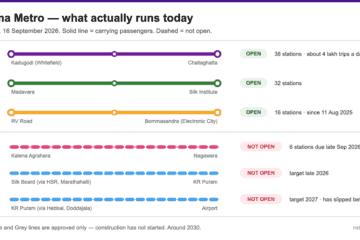
Pillar 1: Metro Phase 2A. The BMRCL Phase 2A airport link via Yeshwanthpur Junction is expected to be operational by late 2027. This single infrastructure event will collapse the airport commute from 55 minutes to 32 minutes door-to-door for Tiara residents. Comparable corridors that have benefited from metro openings (Whitefield, Yelahanka, Banashankari) saw 18-26 percent one-year step-up in rental and capital values upon operationalisation.
Pillar 2: Supply constraint. Within a 5-kilometre radius of Tiara, only 1,850 units of branded luxury (Rs 3 Cr+) are in the launch or under-construction pipeline through 2030. Annual absorption in this band has averaged 720 units over the past three years. The supply-demand imbalance favours price strength.
Pillar 3: Brand premium durability. Godrej-branded apartments in Bangalore have traded at an 8-12 percent resale premium over comparable non-Godrej inventory for 8+ years. This premium has been stable through market cycles, suggesting it is structural rather than speculative.
5-Year Total Return Scenarios
| Scenario | Capital Apprec. | Rent Yield | Total IRR |
|---|---|---|---|
| Best Case | 14% | 3.0% | 17.0% |
| Base Case | 11.5% | 2.5% | 14.0% |
| Downside | 7% | 1.8% | 8.8% |
The base-case 14 percent IRR is competitive against the Nifty 50 average of 12-13 percent and the typical Bangalore residential average of 9-11 percent, but it is below the returns generated by mid-cap equity over the same window. The investment case for Tiara is therefore about diversification (real estate as a non-correlated asset) and the embedded option on metro Phase 2A, not about beating equity returns outright.
The Rental Income Reality Check
Comparable furnished 3 BHK luxury inventory in Yeshwanthpur and Malleshwaram rents at Rs 65,000-85,000 per month. Apply that to a Rs 3.5 crore investment and the gross yield is 2.2-2.9 percent. After deducting maintenance (Rs 9,500), property tax (Rs 2,800), vacancy provision (5 percent), and brokerage (8 percent of annual rent), net yield drops to 1.6-2.1 percent.
For comparison, a fixed deposit gives 7 percent, a debt mutual fund 7.5-8.5 percent, and a balanced equity fund 11-13 percent over comparable windows. If your investment thesis depends on monthly rental cashflow, premium luxury Bangalore is the wrong asset class. Tiara works for buyers who can absorb low rental yield in exchange for the appreciation upside.
NRI Investment Angle
NRIs from the Gulf, US and Singapore are the most active investor cohort in Bangalore luxury, accounting for roughly 35 percent of bookings in the Rs 3-6 Cr band. The investment case for NRIs adds three additional factors. First, currency hedge — Indian residential is INR-denominated, providing a partial offset against USD-INR depreciation over multi-decade holding periods. Second, ease of management — branded developers like Godrej allow remote transaction execution through certified channel partners. Third, return-home option — many NRIs eventually return to India, and a Bangalore base in a metro-connected location preserves optionality.
For NRIs financing through home loans, the FEMA-permitted 80 percent LTV makes the equity commitment manageable. A Rs 3.5 crore 3 BHK requires Rs 70 lakh own contribution and Rs 2.8 crore loan, which most senior tech professionals overseas can fund comfortably.
Risks and What Could Go Wrong
Metro Phase 2A delay: BMRCL has slipped previous deadlines by 18-30 months. If Phase 2A operationalisation slips to 2029, the rental and capital uplift will defer by 1-2 years.
Possession delay: While Godrej’s track record is strong, a 4-month overrun on a Rs 3.5 crore investment financed at 8.5 percent costs roughly Rs 9.5 lakh in additional carrying cost.
Macro slowdown: A sustained tech sector correction (similar to 2002 or 2008) could compress luxury demand for 18-24 months. Bangalore is more cyclical than Mumbai or Delhi residential.
Supply surge: If multiple competitor projects launch simultaneously in 2027-2028 to coincide with the metro opening, the supply boost could mute the appreciation step-up.
Our Investment Verdict
Godrej Tiara is a credible long-horizon investment (7-10 years) for buyers seeking real estate diversification with brand-name execution and embedded metro Phase 2A upside. The base-case 14 percent IRR is competitive but not exceptional, and the investment case depends materially on capital appreciation rather than rental income.
It is not the right investment for buyers seeking monthly cashflow, for buyers with horizons under 5 years, or for buyers who cannot absorb 18-24 month delays in either possession or the metro upside. For yield-focused investors, fixed deposits, debt funds or commercial real estate are better fits.