Navaratna Agrahara Locality Guide 2026: Is North Bangalore’s Airport Suburb Worth It?
Navaratna Agrahara has moved from a quiet village name to one of North Bangalore’s most-searched localities in just a few years. The pull is simple: it sits inside the airport growth corridor at a price point below the established northern suburbs.
This guide explains what living and investing in the locality actually looks like in 2026 — the connectivity, the prices, the social infrastructure and the honest trade-offs. Our team studied the micro-market on the ground so you can decide with clear eyes.
If you are weighing a home purchase along the airport belt, treat this as a buyer’s briefing rather than a brochure. We cover what works, what is still missing, and who the suburb genuinely suits.
Where Is Navaratna Agrahara?
Navaratna Agrahara is a village-turned-suburb in North Bangalore, set close to the Devanahalli belt and Kempegowda International Airport. It lies just off NH-44, the Bengaluru–Hyderabad highway.
The Outer Ring Road is roughly 2 km away, and the airport terminal is a 15–20 minute drive. For years this was a plotted-land market; today the locality is firmly an apartment market.
That shift matters. When branded developers commit to a location, roads, water lines and retail tend to follow. The suburb is now in exactly that upgrade phase.
Geographically, the area is a transition zone — no longer rural, not yet a dense city suburb. That in-between stage is what creates both the value and the risk for buyers.
The pin code and revenue boundaries still echo the village past, but on the ground the change is visible. Compound walls, marketing offices and crane lines now mark plots that were farmland barely a decade ago.
Connectivity: Airport, Metro and Highways
Connectivity is the headline reason buyers look at Navaratna Agrahara. The location is multi-modal in a way few emerging suburbs can claim.
By road, NH-44 links the suburb to Hebbal in under 40 minutes off-peak. Kempegowda International Airport is the closest major hub, a clear advantage for aviation staff and frequent-travel households.
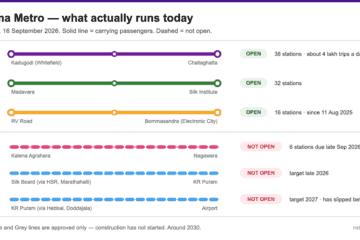
By rail, the Doddajala station on the Namma Metro Blue Line sits about 1.8 km away. Once the airport line is fully operational, the locality gains a congestion-proof route into the city.
The Devanahalli railway station adds a low-cost suburban-rail option. Few North Bangalore localities combine road, metro, rail and air access the way this one does.
The catch is timing. Road access is good today, but the full value of the metro arrives only when the airport line opens. Buyers should weigh present access against the connectivity promised over the next two to three years.
How the Suburb Compares Nearby
Set against its neighbours, Navaratna Agrahara occupies a useful middle ground. Devanahalli town is more built-up but pricier in its prime pockets, while the deep interior villages are cheaper but poorly connected.
The locality balances both — closer-in access than the far villages, lower entry pricing than the established Devanahalli core. Our comparison of Devanahalli, Navaratna Agrahara and Hebbal goes deeper on this trade-off.
For a buyer, the takeaway is that the suburb is rarely the cheapest or the most convenient option, but it is often the best-balanced one along the airport belt.
Navaratna Agrahara Locality Snapshot
| Factor | Detail |
|---|---|
| Airport | 15–20 min drive |
| Metro | Doddajala approx 1.8 km |
| Avg price | ₹5,800–6,000/sq ft |
| Growth 2026 | 12%+ tipped |
| Config | Mostly 2 & 3 BHK |
| Stage | Emerging, fast-developing |
Social Infrastructure: Schools, Hospitals and Retail
This is where Navaratna Agrahara is still catching up. The suburb has the bones of good infrastructure, but not yet the density of an established locality.
On schooling, Akash International School, Oxford English School and several airport-belt international schools fall within a 15-minute radius. The choice is reasonable and steadily growing.
Healthcare leans on Akash Hospital, Regal Hospital and Columbia Asia toward Devanahalli. These cover routine and emergency needs, though specialist care may still mean a trip toward Hebbal.
Retail is the thinnest layer. A D-Mart and local supermarkets serve daily needs, while large-format malls and dining are still planned rather than built. Banks, pharmacies and ATMs are now common along the main roads.
For weekend shopping and entertainment, residents currently drive toward Hebbal. Early buyers in Navaratna Agrahara accept this gap in exchange for a lower entry price and the promise of catch-up over time.
Property Market and Prices
Average apartment rates in Navaratna Agrahara sit near ₹5,800–6,000 per sq ft, with branded launches commanding a premium above that. Plotted land trades higher per square foot in select pockets.
The price story is appreciation-led. The wider Devanahalli belt is tipped for 12%-plus growth in 2026 as the metro nears completion and jobs cluster around the airport.
Rental yields, by contrast, are modest — typically 2.8–3.5% gross. The return case here rests on capital growth, not monthly cash flow, which shapes who the suburb suits.
Price discovery is still imperfect. Two projects a kilometre apart can quote noticeably different rates depending on brand, amenities and construction stage. That gap is an opportunity for a careful buyer and a trap for a rushed one.
For a deeper price breakdown, see our guide to North Bangalore airport belt property prices. Branded options here include Mahindra Navaratna on Airport Road.
The Infrastructure Pipeline
What separates a stagnant suburb from a rising one is the pipeline of public works. On that measure, the airport corridor is unusually strong.
The metro’s airport line is the single biggest catalyst. Highway widening, the satellite town ring road and continued expansion of the KIADB Aerospace Park add further momentum across the decade.
Each upgrade tightens commute times and brings jobs closer. For a buyer, the practical point is that today’s gaps in Navaratna Agrahara are scheduled to close, not left open indefinitely.
Rental Market Outlook
The rental market is young but real. Demand comes mainly from airport and logistics employees, aerospace-park staff and IT professionals who want a shorter northern commute.
Typical rents for a 2 BHK in the airport belt run roughly ₹18,000–24,000 a month, with 3 BHK homes higher. Rents should firm up as the metro opens and new offices come online.
For a full investor view, our guide to rental yield near Bangalore airport breaks down the numbers in detail.
Who Is Buying in Navaratna Agrahara?
The buyer base is young and practical. Dual-income IT couples, airport and logistics staff, and long-horizon investors make up most of the demand.
End-users want a branded home near work without Hebbal pricing. Investors are betting that the corridor’s infrastructure pipeline will lift values over a six-to-eight-year hold.
This profile favours 2 and 3 BHK apartments, and it points to a steady rental pool once handovers begin across Navaratna Agrahara.
Pros and Cons of Living Here
The pros. Airport access is genuine, the metro is close, entry prices undercut older suburbs, and branded developers are actively building — a strong signal for an emerging area.
The cons. Social infrastructure is still maturing, large retail is years away, and heavy new supply can slow short-term resale. The locality rewards patience, not speed.
Our verdict: Navaratna Agrahara is a credible buy for owner-occupiers and investors with a long horizon. It is a weaker fit for anyone needing a fully built-out neighbourhood today or a quick resale exit.
Before booking, verify project approvals on the Karnataka RERA portal and visit on a weekday morning to judge the real commute for yourself.
Practical Tips Before You Buy
First, always insist on the RERA registration number and verify it independently — never rely on a brochure alone.
Second, check the khata type and the approved building plan. Emerging areas can carry title and approval complications that established suburbs have already cleared.
Third, study the developer’s delivery history. In an under-construction market, the builder’s track record is your main protection against delay.
Finally, budget honestly for the wait. A home in this suburb is a multi-year commitment, and your capital stays locked through the construction window. If that timeline does not match your plans, it is far better to know before you pay a token than after.
Frequently Asked Questions
Is Navaratna Agrahara a good place to invest in 2026?
How far is Navaratna Agrahara from the airport?
What are property prices in the area?
Is the suburb good for families?
Should I buy now or wait?
Related Reading
Disclaimer: Prices and infrastructure timelines for Navaratna Agrahara are indicative and subject to change. Verify project and approval details with developers and the Karnataka RERA portal before any purchase decision.