Yellow Line Metro Bangalore: One Year On, What Prices Did
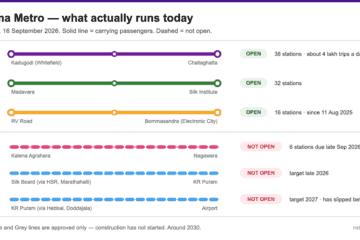
The Yellow Line metro has been open since 11 August 2025. It is carrying over a lakh boardings a day.
End to end, RV Road to Bommasandra takes 31 to 38 minutes. Flats within a kilometre of a station now carry roughly a 5–10% premium over comparable stock further out. That is close to what we forecast before it opened, and well below what the corridor’s sellers are claiming.
We published a forecast on the Yellow Line metro corridor before it opened. It said the catchment would see a one-time step-up of 6–9% in the year after commissioning. The line has now been running for over a year, so the honest thing is to go back and check the number rather than quietly leave the prediction up.
Short version: the forecast held. Properties inside a one-kilometre walk of a Yellow Line metro station are transacting at about 5–10% above equivalent stock outside that ring. Electronic City sits around Rs 7,000–7,500 a sq ft and Bommasandra around Rs 6,000–6,500. The step-up arrived, it arrived roughly on schedule, and it was not the windfall the hoardings promised.
What the line actually changed
The commute is the real story. Hosur Road at 9am was one of the worst stretches in the city, and a 31 to 38 minute run from Bommasandra to RV Road is a different proposition from an hour and a half in a cab. Over a lakh daily boardings within the first year says people switched, which is the part that actually moves rents.
Sixteen stations serve the corridor: RV Road, Jayadeva Hospital, BTM Layout, Silk Board, HSR Layout, Bommanahalli, Hongasandra, Kudlu Gate, Singasandra, Hosa Road, Beratena Agrahara, Electronic City, Konappana Agrahara, Huskur Road, Hebbagodi and Bommasandra. They do not all behave the same way, and the difference between them is mostly about what sits within walking distance.
Jayadeva Hospital is the one to watch next. It is where the Yellow Line will meet the Pink Line, and the Pink Line has not opened yet. When it does, this corridor gets a direct link into Bannerghatta Road and, later, north Bengaluru. Our guide to which Namma Metro lines actually run sets out where that has got to.
Be careful with the numbers you are shown
You will see appreciation claims on this corridor ranging from 8% to 19%. Almost all of them come from developers and portals with something to sell in the catchment, and they usually measure from a low base year, or quote asking prices rather than registered transactions. Treat them as advertising.
The defensible figure is narrower. A 5–10% premium inside a one-kilometre ring, against comparable stock outside it, is what holds up when you compare like with like. If someone quotes you a bigger number, ask which two years they are comparing and whether the price is an asking price or a registered one.
The other thing worth knowing is that this uplift is a one-time repricing, not a rate of growth. It happens once, around the opening, and then the catchment settles back into outperforming the surrounding area by a point or two a year. Anyone selling you 10% a year forever on the strength of a metro station is selling you the step-up as if it repeats.
Which station catchments held up best
Three Yellow Line metro catchments did better than the corridor average, and for the same reason in each case: people can actually walk to the station. Hosa Road has a cluster of branded launches inside the ring. Electronic City has the Infosys, Wipro and HCL campuses feeding it. Bommasandra is the terminus, which means a seat in the morning and the industrial belt’s tenant demand on top.
| Catchment | Rate now | What drives it |
|---|---|---|
| Electronic City | Rs 7,000–7,500/sq ft | Campus demand, walk-to-work |
| Bommasandra | Rs 6,000–6,500/sq ft | Terminus, industrial tenants |
| Hosa Road | Corridor average | Dense branded supply in the ring |
| Anything 1 km+ out | No metro premium | Still sold as “metro connectivity” |
That last row is the one to read twice. A project two kilometres from a station is still described as metro-connected in the brochure, and it did not get the repricing. The premium is a walking-distance effect, and it falls away fast past about a kilometre. Detail on the pockets in our Electronic City area guide and the Bommasandra page.
Is it too late to buy here now?
For the Yellow Line metro trade specifically, yes. The step-up has happened and it is in the price. If your reason for buying is that a station is about to open and lift the value, that reason expired in August 2025 on this corridor.
That is not the same as saying do not buy. The corridor is a perfectly reasonable place to own a home if you work along it, because the thing you are buying now is the commute itself rather than a bet on one. Thirty-odd minutes to RV Road on a train, every day, is worth paying for if it is your route.
The remaining upside on this corridor is the Jayadeva interchange and Phase 2 towards Attibele, and both are years out. If you want the pre-opening trade rather than the post-opening one, you are looking at a different corridor now, not this one.
The last mile still decides it
The biggest variable in whether a flat here got the uplift is dull and physical: can you walk to the station, and would you want to. Six hundred metres on a lit footpath and twelve hundred metres along an unpaved service road are not the same journey, even though a brochure will call both of them close to the metro.
Walk it yourself, at the hour you would actually be walking it. Check the footpath, the road crossings and the lighting. This takes fifteen minutes on a site visit and it tells you more about the value of the station than any price sheet will.
Some developers along the corridor now run their own shuttles to the nearest station, typically every 20 to 30 minutes at peak. Where that service is real and funded, it widens the useful catchment considerably. Ask whether it is written into the maintenance agreement or whether it is a launch-period promise.
What changed for landlords
Rents moved before resale did, which is the usual order. The tenant pool widened because the corridor stopped being a commute people refused, and that shows up faster in a twelve-month rental cycle than in registered sale prices.
The other shift is corporate lets. Large employers along Hosur Road set housing allowances against commute friction, and once the train cut that materially, more of this corridor fell inside their approved zones. Corporate tenants sign longer, pay on time and look after the place, so this is the part of the metro effect that actually compounds for a landlord.
Phase 2, and what is still coming
Phase 2 would carry the line past Bommasandra towards Attibele and Hosur, and it is still at the detailed-report stage with BMRCL. On the trajectory it is on, that is a 2030–31 proposition, which is long enough that it should not be a deciding factor in a purchase today.
The nearer change is Jayadeva. Once the Pink Line opens there, the Yellow Line stops being a single spur into the centre and becomes part of a network, with Bannerghatta Road and eventually north Bengaluru reachable without a change onto the road. That is a real improvement to this corridor and it is not priced in yet, because it has not happened.
Questions buyers ask about the Yellow Line
Is the Yellow Line metro open?
Yes. It was inaugurated on 10 August 2025 and has been carrying passengers since the following day. Sixteen stations run from RV Road to Bommasandra, and the full journey takes 31 to 38 minutes.
How much did the metro raise property prices here?
About 5 to 10% for stock within a one-kilometre walk of a station, measured against comparable stock outside that ring. It is a one-time repricing around the opening, not an annual growth rate, and larger figures you see quoted usually come from sellers.
Is it too late to buy for the metro gain?
For the opening trade, yes; it is in the price already. Buying here now makes sense if you want the commute, or if you are taking a long view on the Jayadeva interchange and Phase 2, both of which are still ahead.
Which stations are best to buy near?
Electronic City, Bommasandra and Hosa Road held up best, because each has genuine walkable density around the station. The deciding factor is the walk, not the station name, so check the distance on foot before you accept a catchment claim.
Does HSR Layout have a Yellow Line station?
There is a station named HSR Layout on the line, near the Silk Board end, but it does not sit inside HSR Layout itself. The HSR Layout guide explains how far it actually is from each sector.
When does Yellow Line Phase 2 open?
There is no firm date. The Yellow Line metro extension towards Attibele is still at the detailed-project-report stage with BMRCL, which puts it around 2030 to 2031 at the earliest. Do not pay a premium today for it.
Related Reads
Line status, journey times and ridership checked against BMRCL and public reporting on 16 September 2026. Rates are indicative catchment ranges, not a valuation of any single project.