Integrated Township Bangalore – The Built or Drawn Test
Almost every large Bengaluru project now calls itself a township. Five components decide whether it is one, and only one test tells you if they will ever be built.
Buyer guide | The five-component test | Delivered vs promised | Our Rating: 4.6/5 useful
Our verdict: pay the township premium only where the components are standing and trading. A masterplan with a school marked on it is a project with a drawing, not a township.
What makes an integrated township Bangalore buyers should pay for
The phrase integrated township Bangalore has been stretched to cover anything above about thirty acres with a clubhouse, which makes it close to useless as a shortlisting filter. A genuine township is defined by what else exists on the land besides homes.
Five components matter: residential at scale, retail for daily needs, education, healthcare access, and workspace or substantial managed open space. A development with all five internalises ordinary life; one with residential plus a clubhouse is a large gated project, which is a different and cheaper product.
The distinction is worth real money because township product in Bengaluru commands roughly 10 to 30 percent over a standalone project in the same locality. Paying that premium for a large gated scheme with a masterplan drawing is the single most common overpayment in this segment.
The only test that matters: built or drawn?
Here is the uncomfortable structural truth about township development, and it is not dishonesty on the developer’s part. Residential funds the project, so residential gets built first. The mall, the school and the healthcare only become viable once enough families have moved in to support them commercially.
The consequence is that the first two or three thousand residents of a new township live in a construction site with a long commute and none of the community they were shown. In our experience advising buyers across Devanahalli, Sarjapur and Hoskote, the apartments arrive broadly on schedule and the township arrives several years late.
So the test is binary rather than a matter of degree. Walk the estate and ask of each of the five components: is it open and trading today, or is it a line on a plan? A component you can buy a coffee in is worth the premium. One marked on a masterplan is worth nothing until it opens.
The clearest Bengaluru example of a township that passes that test is Bhartiya City at Thanisandra, where the hotel, the mall, the retail street, a school and seven residential phases are all built and occupied. We set out what that actually delivers in our guide to living inside that township.
The integrated township Bangalore landscape
Four estates we have assessed in detail illustrate the range, from fully delivered to recently launched. The right-hand column is the honest status rather than the marketing position.
| Estate | Scale | Status of the non-residential components |
|---|---|---|
| Bhartiya City, Thanisandra | approx. 125 acres | Hotel, mall, retail street, school all built and trading |
| Tata Carnatica, Shettigere | approx. 140 acres | Under development; ask which phases are complete |
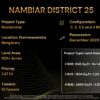
| Nambiar District 25, Dommasandra | 100+ acres | Launched; verify school and retail built vs planned |
| Devanahalli township belt | varies | Several estates at different maturities on one corridor |
The top row is the only one where a buyer can inspect every component before signing, and that is why we rate the campus so highly despite its access road. The others require the built-or-drawn question asked component by component, in writing, before any booking amount changes hands.
Our assessments of the second and third are in the Tata Varnam review and the Nambiar District 25 review, and the township-against-township comparison on the airport corridor sits in Tata Carnatica versus Brigade Orchards.
Where the premium is defensible, and where it is not
This is the part most guides get wrong by treating township living as universally better. The premium is worth paying in inverse proportion to how good the surrounding locality already is, which means it is a function of location rather than of the estate.
On the airport corridor, buying outside a township means driving 10 to 20 kilometres for a multi-speciality hospital or a large-format school, every single time. A 25 to 30 percent premium for having those inside the gates is defensible there, and we have said so in our Shettigere price guide.
In Whitefield, Koramangala or HSR Layout the same premium is much harder to justify, because malls, hospitals, schools and restaurants already sit within two to five kilometres outside any gate. You would be paying to duplicate infrastructure you can already reach, which is a poor trade.
The rule we give buyers is simple: the further the locality is from working social infrastructure, the more an integrated township Bangalore buyers are considering is worth. In a mature inner locality, buy the better-located standalone project and use the city.
What integrated township Bangalore living changes daily
The clearest difference shows up in the weekday evening. A family in a standalone tower drives 4 to 7 kilometres for groceries, a haircut, a restaurant or a paediatrician. Inside a working township those are walks or two-minute drives on internal roads, which removes perhaps six to eight short car journeys a week.
School logistics change most of all. A walkable school on campus removes the single most time-consuming item in a Bengaluru parent’s day, and across a ten-year school career a walk instead of a 25-minute each-way van run gives back something in the order of 2,000 hours.
The weekend pattern shifts too, because errands and ordinary evenings get handled inside the boundary. Residents of mature townships consistently tell us they leave the estate mainly for work and family visits, which is a different relationship with the city than a standalone apartment produces.
What a township cannot fix is anything outside its gates. It can build a school, a mall and a hospital; it cannot widen the arterial road its residents commute on. On every corridor we cover, the approach road remains the binding constraint on quality of life.
The seven questions to ask before buying into one
On any integrated township Bangalore shortlist, ask of each of the five components whether it is open and trading today. Ask which phases of the total acreage are complete, which are under construction and which are not yet launched, because that sequence tells you how many years you will live beside an active site.
Ask which amenity is shared estate-wide and which is exclusive to your phase, since a shared clubhouse sized for three phases feels different once a fifth arrives. Ask for the maintenance charge from a delivered phase rather than an estimate for the new one, because launch estimates are routinely optimistic.
Ask what the one-time corpus per square foot is and whether it transfers to the residents association on handover. Ask how many residential phases remain to be launched on the land. Finally, verify the registration for your exact phase on the Karnataka RERA portal, since phases register separately and each carries its own filed completion date.
Resale, and the supply problem nobody mentions
A delivered integrated township Bangalore estate earns its premium back at resale, because a buyer is looking at infrastructure that visibly exists rather than a hope. That removes the single largest discount factor in Bengaluru resale, which is uncertainty about whether the promised community will ever materialise.
A mature estate also creates a working price benchmark. Unlike a one-off tower where the first resale in three years sets the price with no reference point, a multi-phase township has continuous transaction history across phases and vintages that both sides can check.
The caution is internal supply. Because the estate keeps launching phases, a resale seller competes with the developer’s own inventory, offered at current prices with a construction-linked payment plan and a brand-new flat. That caps resale pricing on older phases for as long as the developer is still selling.
Expect sound liquidity rather than outsized gains, and plan an eight-year-plus hold so that the developer has finished selling before you need to. Our note on buying into a large apartment project quantifies that competition window.
Frequently asked questions
What qualifies as an integrated township Bangalore project?
Five components on the land: residential at scale, daily-needs retail, education, healthcare access, and workspace or substantial managed open space. Residential plus a clubhouse is a large gated project, not a township.
How much premium does township product carry?
Roughly 10 to 30 percent over a standalone project in the same locality, and up to 25 to 30 percent on corridors like the airport belt where outside infrastructure is 10 to 20 km away.
What is the single most important check?
Built or drawn. Walk the estate and ask of each component whether it is open and trading today. A component you can buy a coffee in is worth the premium; one on a masterplan is worth nothing yet.
Is a township always better than a standalone project?
No. The premium is worth paying in inverse proportion to the surrounding locality. In Whitefield or HSR Layout you would be duplicating infrastructure already two to five kilometres away.
How does a township resell?
Soundly rather than spectacularly. Visible infrastructure removes the biggest resale discount factor, but you compete with the developer’s own new phases, so plan an eight-year-plus hold.