Bangalore Airport City Real Estate 2026: What Is Actually Built

For most of the last two decades, the Bengaluru property story was written in the south and the east – Whitefield, Sarjapur, Electronic City, HSR Layout. The north, beyond Hebbal and out toward Devanahalli, was the airport road you used twice a year. That has changed completely. Today the conversation around the airport city district is one of the most active in the city, driven by a cluster of infrastructure and economic projects converging on a single corridor at the same time.
The airport is no longer just a place you fly from – it is becoming the anchor of a planned aerotropolis, and the land around it is being repriced accordingly.
This article is a practical, grounded walkthrough of what the airport city district actually offers in 2026 and what it is likely to become over the rest of the decade. We will look at what the Bengaluru Airport City project is, its phases and anchor tenants, how the surrounding infrastructure is reshaping Devanahalli, the impact on land and plot demand, who is investing, realistic timelines, and an honest risks section. The goal is the full picture – the genuine opportunity and the things that can go wrong – so you can decide whether this corridor belongs in your plan.
What Exactly Is Bengaluru Airport City?
Bengaluru Airport City is a large, planned mixed-use district being developed on land adjoining Kempegowda International Airport by Bangalore International Airport Limited, the airport operator. Think of it as a city built around the airport rather than an airport sitting on the edge of a city – the global term for this is an aerotropolis. The plan brings together business parks and offices, a convention and exhibition centre, retail and hospitality, healthcare and education, and significant green and public space, all within a short drive of the terminals.
This is the single most important catalyst behind Bangalore Airport City real estate, because it converts raw airport-adjacent land into a destination with its own daytime economy. In short, the airport city district generates demand from within, not merely on proximity to a runway.
What makes the airport city district story credible is that it is not a paper concept. Parts of the district are already operational or under active construction – a business park, a luxury hotel, and the early phases of office and retail space have moved from drawings into steel and glass. When evaluating the airport city district, this distinction matters enormously: you are looking at a project with a live anchor (the airport), a funded master developer, and visible ground activity, rather than a speculative township that exists only in a brochure.
Phases and Anchors: How the District Is Being Built
Bengaluru Airport City is being delivered in phases over many years, which is typical for a district of this scale. The first phase concentrates on the most commercially proven uses – Grade-A office space in a business park, a convention centre to capture MICE (meetings, incentives, conferences and exhibitions) traffic, premium retail and dining, and hospitality keyed to business travellers.
Later phases expand into health, education, and broader commercial and recreational uses. For anyone tracking Bangalore Airport City real estate, the phasing is the clearest signal of where value will land first and where it will follow.
The anchors are what give the district its pull. The airport itself is the primary anchor, providing constant footfall and a reason for companies to locate nearby. A business park draws employers and the jobs that create housing and retail demand. A convention centre brings event-driven visitors who fill hotels and restaurants. Multinational tenants, aerospace and technology firms, and aviation-linked services are the kind of occupiers this format is designed to attract.
Each anchor that signs strengthens the underlying demand for the airport city district across both commercial and residential segments in the surrounding catchment. The more anchors that commit, the more defensible the airport city district thesis becomes.
- Business park: Grade-A office space targeting technology, aerospace, and corporate occupiers.
- Convention and exhibition centre: A MICE anchor that drives event-led visitor footfall and hotel demand.
- Retail and hospitality: Premium shopping, dining, and hotels keyed to travellers and the working population.
- Healthcare and education: Planned in later phases to round out the district into a self-contained ecosystem.
- The airport itself: The permanent anchor – a second runway and Terminal 2 sharply increase capacity and footfall.
The Infrastructure Stack Reshaping North Bangalore
The airport city district does not exist in isolation – it sits on top of a stack of infrastructure projects that reinforce one another. The airport’s second runway and the expansive Terminal 2 have already lifted Kempegowda International Airport’s passenger and cargo capacity into a different league, and capacity is what attracts businesses, jobs, and the property demand that follows. More flights and more cargo mean more reasons for logistics, aerospace, and corporate occupiers to plant themselves nearby, which is precisely the demand that underpins Bangalore Airport City real estate.
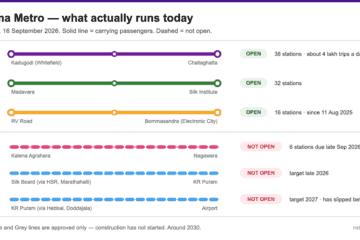
Three other projects matter just as much. First, the KIADB Aerospace Park – a dedicated industrial cluster developed by the Karnataka Industrial Areas Development Board for aerospace, defence, and precision manufacturing – sits in the same Devanahalli belt and brings large employers and skilled jobs. Second, the proposed airport metro line (the Blue Line connecting the city and the airport) promises to solve the corridor’s biggest weakness, last-mile connectivity, once it is operational.
Third, the Satellite Town Ring Road (STRR) is creating an outer orbital that links Devanahalli to surrounding towns and to the wider highway network. Together, these turn the area from an airport edge into a genuine economic node – and that is the foundation of the airport city district thesis.
Impact on Land and Plot Demand in Devanahalli
The most visible effect of all this activity is on land and plotted-development demand in and around Devanahalli. When a corridor gains a major jobs engine, land closest to it tends to appreciate first, and plots are the purest way for an investor to take a position on that land. This is why so much of the airport city district interest has flowed into plotted projects rather than only apartments – a plot lets a buyer hold appreciating land directly, build to their own timeline, and avoid the construction-delay risk that comes with under-construction flats. For a large share of Bangalore Airport City real estate buyers, plotted land is simply the cleanest way to participate in the corridor’s growth.
Plotted demand in this belt is being driven by a mix of end-users wanting to build villas or homes near the airport job market and investors betting on long-run appreciation. Standard plot sizes such as 30×40 and 30×50 remain the most liquid and sought-after formats because they suit both self-build homes and resale, and they sit at the centre of most portfolios here.
For a deeper view of how values have moved historically, our note on Devanahalli land price appreciation is a useful companion read, and our overview of plotted development in Devanahalli explains the formats and approvals to look for. One project frequently cited in this conversation is Arvind The Park, Devanahalli, a plotted development by Arvind SmartSpaces positioned to benefit from exactly this dynamic.
The airport city district: The Infrastructure Snapshot
The table below summarises the key projects shaping this corridor and, by extension, the Bangalore Airport City real estate market. Treat the status notes as indicative for understanding rather than as guarantees – timelines on large infrastructure shift, and you should confirm the latest position from official sources before acting.
| Project | What It Is | Why It Matters |
|---|---|---|
| Bengaluru Airport City | Planned business, convention, retail and office district | Core demand engine for the corridor |
| Terminal 2 and second runway | Major capacity expansion at the airport | More flights, cargo, jobs and footfall |
| KIADB Aerospace Park | Aerospace and defence manufacturing cluster | Large employers and skilled jobs nearby |
| Airport metro (Blue Line) | Proposed metro link from city to airport | Solves last-mile connectivity once live |
| Satellite Town Ring Road (STRR) | Outer orbital linking Devanahalli to nearby towns | Wider regional access and logistics flow |
| Plotted development | 30×40 and 30×50 plots in Devanahalli belt | Direct, liquid way to hold appreciating land |
Who Is Investing in the airport city district?
The buyer pool here is unusually broad, which is itself a sign of a maturing corridor. At the institutional end, the airport operator and its development partners are committing capital into the district directly, and the state government is actively courting investment through bodies such as Invest Karnataka. Industrial land in the belt is allocated and managed by KIADB, which anchors the manufacturing and aerospace tenants.
These institutional commitments are the bedrock on which retail the airport city district demand is built, and they are the clearest reason the airport city district is treated as more than a passing trend.
At the developer level, reputed names have moved in with plotted projects, villa communities, and apartments aimed at the airport job market. At the retail-investor level, the buyers split into a few clear groups: NRIs and high-net-worth individuals seeking land as a long-term store of value, professionals working in the airport and aerospace ecosystem who want to live nearby, and pure land investors taking a multi-year position. This diversity of demand is healthy – it means Bangalore Airport City real estate is not dependent on any single buyer type to sustain it.
Institutional and government
The airport operator, its master-development partners, KIADB, and the state’s investment-promotion machinery are all committed to the corridor. This is the most durable layer of demand for the airport city district because it is policy-backed and capital-intensive.
Developers and end-users
Established developers are launching plotted and villa projects, while end-users employed across the airport and aerospace ecosystem want homes within a short commute. Both groups convert infrastructure into lived-in demand.
Long-term land investors
NRIs, HNIs, and patient domestic investors are buying plots to hold through the corridor’s maturation. For this group, the airport city district is a land-banking play with a clear catalyst attached, and the breadth of buyers is one reason the airport city district demand looks structurally durable rather than purely speculative.
Realistic Timelines: What to Expect and When
Honesty about timelines is where most Bangalore Airport City real estate marketing falls short. A district of this scale does not mature in two or three years – it unfolds over a decade or more, in waves. The near-term wave, already visible, is the first phase of the airport city itself plus the capacity uplift from Terminal 2. The medium-term wave depends heavily on the airport metro reaching the corridor and on later airport-city phases coming online.
The long-term wave is the full build-out of the aerotropolis, the STRR network maturing, and the surrounding land filling in with homes, offices, and amenities. Reading the airport city district through these waves is the most honest way to set expectations.
For an investor, the practical implication is straightforward: this is a hold, not a flip. The strongest returns in the airport city district have historically gone to buyers who entered early on credible, clear-title land and waited patiently through the infrastructure cycle. The table below frames the waves in plain terms.
| Horizon | Key Drivers | What It Means for Buyers |
|---|---|---|
| Near term | Airport city phase 1, Terminal 2 capacity | Visible activity, early demand, entry window |
| Medium term | Airport metro progress, later phases | Connectivity unlock, broader re-rating |
| Long term | Full aerotropolis, STRR network, fill-in | Mature district, end-user driven values |
The Honest Case: Strengths of This Corridor
Good decisions start with a clear list of genuine strengths. Here is where the airport city district earns its reputation as a serious growth play rather than a hype story.
1. A permanent, irreplaceable anchor
Kempegowda International Airport is not moving, and its capacity is rising. An international airport is one of the most durable demand anchors any real-estate corridor can have, and it sits at the centre of every Bangalore Airport City real estate thesis.
2. A planned district, not random sprawl
The airport city is master-planned with defined uses and a funded developer, which tends to produce more orderly, higher-quality growth than unplanned urban expansion – a meaningful long-term positive for surrounding values.
3. A real jobs engine
Between the airport city offices, the KIADB Aerospace Park, and aviation-linked services, the corridor is building a genuine employment base. Jobs create housing and retail demand, which is what ultimately sustains the airport city district.
4. Land as a direct, flexible asset
Plotted formats let buyers hold appreciating land directly, build on their own timeline, and sidestep construction-delay risk. For many, this flexibility is the most attractive feature of the entire corridor.
The Honest Case: Risks You Must Weigh
No corridor is risk-free, and anyone selling you the airport city district without naming the downsides is not being straight with you. These are the risks to underwrite before you commit capital.
- Long timelines: The full district will take many years to mature. Capital committed to the airport city district can be locked up for a long time before the headline appreciation materialises.
- Metro uncertainty: The airport metro is a proposed and under-construction project. Connectivity-driven re-rating depends on it being delivered, and infrastructure schedules slip.
- Title and approval risk: Devanahalli has seen rapid, sometimes disorderly land transactions. Unclear titles, agricultural-land conversion issues, and unapproved layouts are real hazards – independent legal verification is non-negotiable.
- Speculative froth: Strong narratives can push prices ahead of fundamentals. Overpaying near the top of a hype cycle is a genuine way to lose money even in a good corridor.
- Liquidity in downturns: Land and plots can be slow to sell when sentiment turns. Plan for a holding horizon that can ride out soft patches.
- Execution risk on projects: Even with reputed developers, plotted and built projects carry delivery, infrastructure-provision, and specification risks. RERA helps but does not eliminate them.
A Practical Due-Diligence Checklist
Before you sign anything in the Bangalore Airport City real estate market, run through this disciplined checklist. It guards against the most common and costly mistakes that trip up buyers in fast-moving land corridors.
- Verify the RERA registration of any plotted or built project on the official Karnataka RERA portal – never take it on trust.
- Engage an independent property lawyer to confirm clear title, land-use conversion, and a clean encumbrance certificate before any payment.
- Confirm that the layout has the necessary local-authority and planning approvals, not just a developer’s assurance.
- Check the developer’s delivery track record on previous Devanahalli projects rather than relying on marketing.
- Validate distances and connectivity claims – drive the actual route to the airport and to planned metro alignments yourself.
- Underwrite a realistic, multi-year holding horizon and confirm you will not need the capital in the short term.
- Compare multiple projects on price, plot dimensions such as 30×40, approvals, and amenities before committing.
The Outlook to 2030
Looking ahead, the structural ingredients for sustained demand are firmly in place. The airport anchor is permanent and expanding, the airport city is a funded and partly built master plan, the KIADB Aerospace Park brings real employers, and the metro and STRR promise to fix connectivity over time. As the district fills in, North Bangalore is likely to shed its image as a distant airport edge and become a self-contained economic node – and that transition is the heart of the airport city district opportunity.
That said, this will be a gradual maturation, not an overnight transformation. The disciplined way to approach the airport city district is with realistic timelines, rigorous title and approval checks, and a clear sense of which buyer profile you fit. Buy clear-title land, in a credible project, at a price grounded in fundamentals, and the corridor’s anchors give you a genuinely strong foundation. Chase the hype without the discipline, and the same market can disappoint. The infrastructure does the heavy lifting over time; the diligence is yours to bring.
Questions Buyers Ask
What is Bengaluru Airport City?
Why is the airport city district attracting so much interest?
How does the infrastructure affect Devanahalli land and plots?
What is the KIADB Aerospace Park?
When will the airport metro reach the corridor?
What are the main risks of buying here?
Is this a short-term or long-term investment?
Related Reading
- Arvind The Park, Devanahalli – a plotted development positioned to benefit from the airport corridor.
- Devanahalli land price appreciation – how land values have moved in the belt over time.
- Plotted development in Devanahalli – formats, approvals, and what to look for.
Disclaimer: This article is for general information only and is not investment, legal or tax advice. Verify all project details, approvals and RERA status independently before any decision.